

Penny Banks were first introduced in England in the 1840s. They were designed to encourage thrift among working-class people and children by allowing deposits of as little as one penny. Most banks required a minimum deposit of £1.
At a meeting of the Rushden School Board in June 1879 Mr. W. H. Wilkins asked the Clerk, Mr. J. Heygate, if there were any savings banks in connection with the Wellingborough Board Schools. Mr. Heygate replied that there weren’t, and Mr. Wilkins proposed that at the next meeting arrangements be made for providing savings banks for the Rushden Board Schools. The Clerk said that Mr Woods, the Inspector, was very much in favour and would be pleased to give any information.
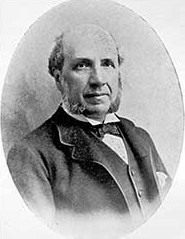
Mr. W. H. Wilkins, J.P.
On 31 July1879 the headmaster of the Board School, Mr. Wood, spoke to the children about the intention of opening a Penny Bank in connection with the school, and on 1 August 1879 Mr. Wilkins visited the Board School and distributed circulars explaining the workings of the bank.
The Rushden School Board Penny Bank was opened on Monday 4 August 1879 and was to be held in the Temperance Hall until the new Board Schools were completed. Anyone could open an account, whether they attended the Board School or not, on Mondays from 12 until 1 o’clock. Any money could be withdrawn on giving one week’s notice, and women and children could deposit or withdraw money in their own names. Interest was 2 ½ per cent per annum.
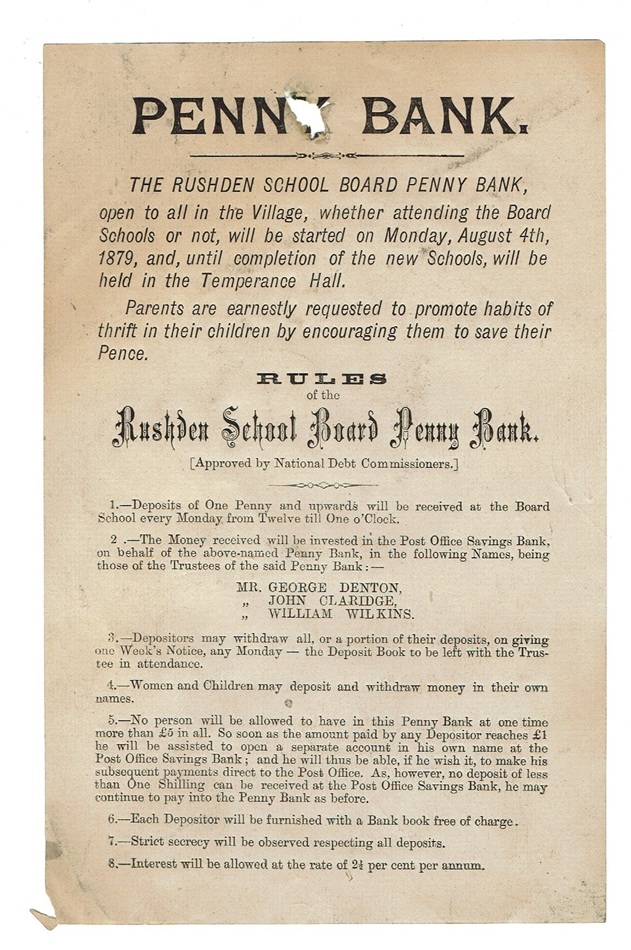
The Rules of the Rushden School Board Penny Bank
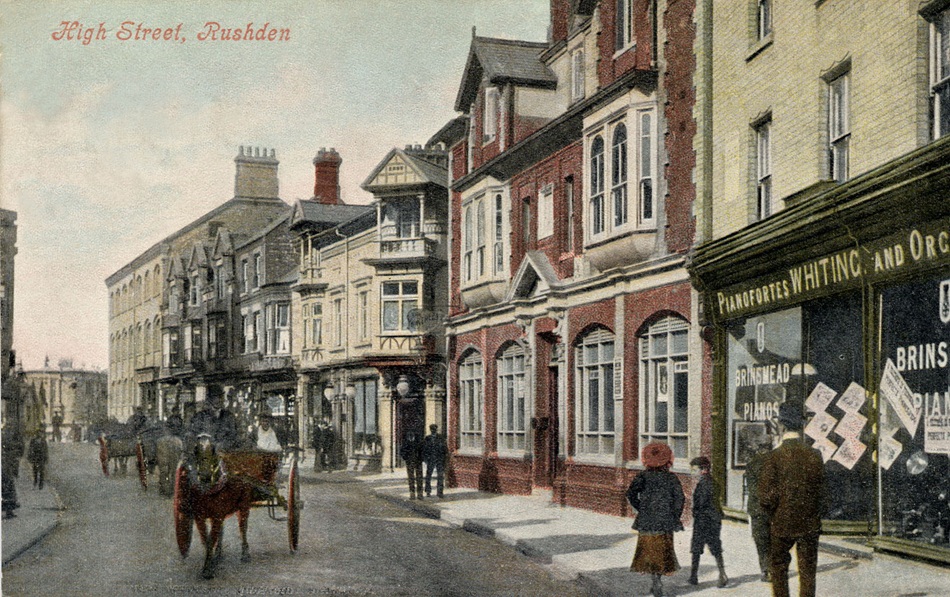
The Waverley Temperance Hotel with the Temperance Hall at the rear
Mr. Wilkins was a regular visitor to the school and on some occasions collected the money of children paying into the penny bank. On other occasions the headmaster collected the money and on 15 November 1880 he wrote in the log book that there was a good attendance at school, but not many depositors in the Penny Bank. However, on 21 February 1881 the headmaster was again in charge of collecting the money and “there were a good number of depositors.” On 18 July 1881 he collected 17/11 in deposits, and on the 8 August 19/-. There were a number of withdrawals in September for Feast Week.

The Board School opened in November 1879 – later became known as Alfred Street School – now Alfred Lord Tennyson School
The Penny Banks were eventually absorbed into the Post Office Savings and generally ceased to exist by 1914.
Mr. Wood, the headmaster of the Board School, died suddenly in October 1904. He had spent the afternoon in Northampton with his wife and daughter, and after returning by train Mr. Wood became ill. He was taken to the home of Mr. Chamberlain in Rectory Road and Dr. Owen was called. Sadly, there was nothing he could do and Mr. Wood passed away at 7.30pm.
In September 1905 Mr. W. H. Wilkins, J.P., also died suddenly. He was out cycling with his niece round Podington and Wymington, and as they were returning to Rushden he fell from his cycle and died almost immediately.