
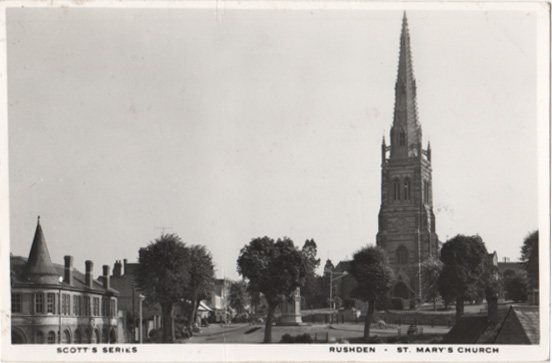
On the 6 March 1925 the Rushden Echo reported that the stranded steel cable which supported a 4 cwt iron weight in the St. Mary’s Church clock had snapped and the weight had fallen 50 feet or more to the ground. A service was being held at the time so it was a frightening experience for the congregation, although the area beneath the weight was railed off in case such a thing should ever happen. Three cables are used to support the weights of the clock, one for the mechanism that causes the “hour” bell to sound, another for the chiming, and the third (the one that broke) for the time. Mr. Ginns was in charge of the clock, and although one cable had been replaced in 1921 the others had not been examined. According to notes written in various parts of the clock the cable for the ‘time’ was put in on 3 March, 1885. A new cable had been ordered.
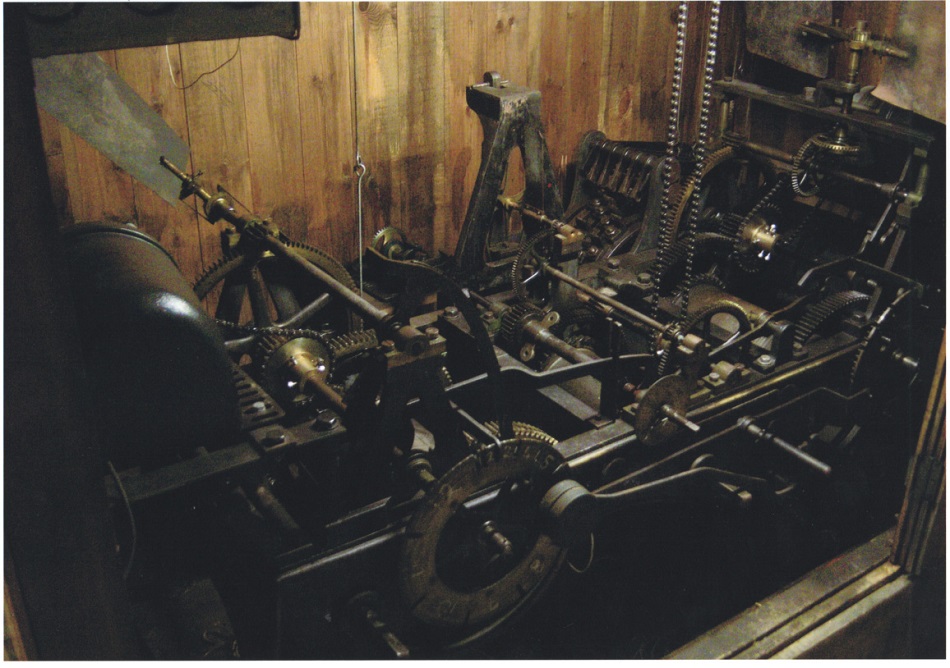
Inside St. Mary’s Church clock
An accident occurred in High Street when a motor-cyclist, Mr. George Groome of Higham Ferrers, tried to turn into College street in front of a cyclist, Mr. Frank Hodson of Peterborough. Mr. Hodson received serious head injuries and was treated by Dr. Muriset. He was taken to the home of his relatives in Crabb Street and for several days was too ill to be interviewed. He was eventually taken to Peterborough Hospital by the Rushden Motor Ambulance with Staff-Sergt. A. Prigmore in charge. His condition was serious and he remained unconscious.

High Street showing the turning into College Street where the accident happened
Rushden Fire Brigade had attended a fire at Higham Park which was fortunately confined to a large shed used for storing engines and machinery. The alarm was raised by Mrs. Wood, who lived nearby, and the Brigade quickly turned out and soon covered the two-and-a half miles with the motor tender towing the steamer.
A threshing drum and the woodwork on a Foden steam waggon were blazing fiercely when the Brigade arrived but Mr. Holt and employees had been throwing water on until the arrival of the Brigade and a good supply of water was obtained from a large pond. The shed was brick built with a concrete roof, and this helped to stop the fire from spreading. The damage was partly covered by insurance.
Captain Fred Knight and Second Officer W. Packwood were not at home at the time the call was received, but were communicated with and were soon on the scene and in charge of the full Brigade.
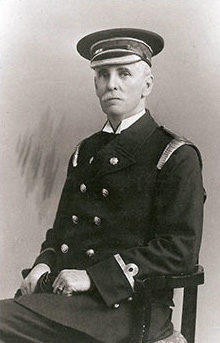
Captain Fred Knight.
At the Council Meeting on the 11 March the subject of an open-air swimming bath was discussed. This subject had been rumbling on for several years with no decision being reached. Several meetings of the committee had been held but in the end it was decided that before further proceeding with the scheme a sub-committee should visit towns already provided with baths and report to a future meeting.
Tenders were received for building eight houses in Oval Road. They were to be divided into two blocks of four houses. Tenders were accepted subject to the contractors undertaking to complete the houses and hand them over to the council ready for occupation by 1 September, 1925.
Block “A,” Mr. Robert Marriott, £1,858
Block “B,” Mr. A. Sanders, £1,800.
These were the lowest tenders for each block.
A planning application from Messrs. A. Austin & Co. for permission to establish a soap-making business at their factory in Graveley Street was considered. A sub-committee had visited Peterborough and inspected the works there, and were of the opinion that no nuisance would be caused by similar works in Graveley Street. It was decided to consent to the business on the understanding that it was entirely a cold process.
.

A bar of Austin soap
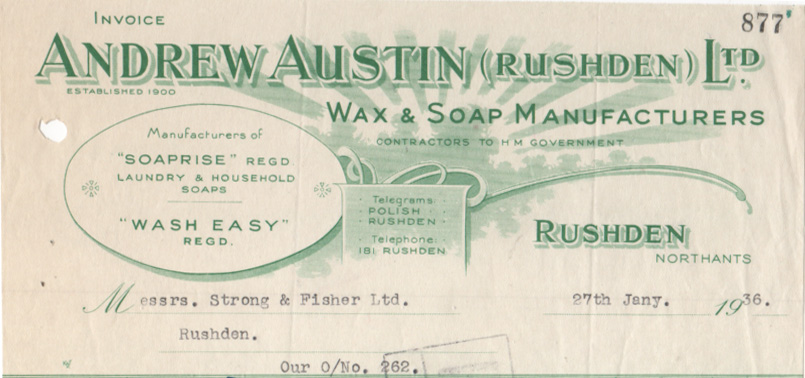
Letterhead for Andrew Austin (Rushden) Ltd.
On the 27 March the Rushden Echo reported that when Mr. Packwood demolished the Clerk’s House in Newton Road he carefully preserved the two date stones, one bearing the inscription “M.R. 1648” and the other “E.R. 1652” I wonder what happened to them.
Newton Road was closed from High Street to Park Road whilst work was carried out, and it was thought to be the first time the road was closed since the Toll Gate had been there.

A sketch showing the Toll Gate at the bottom of Newton Road
In the same paper it was reported that the bowling green and tennis courts being provided by Messrs. John Cave & Sons Ltd., for the use of their employees, were nearing completion. The bowling green was to be 40 yards square, and the two tennis courts 32 yards by 28 yards. It was hoped that all would be ready by Whitsun. 50 employees had already joined the tennis club.

An aerial photo showing the bowling green and tennis courts in the centre of the picture. The swimming pool, in Station Road, can be seen at the bottom of the picture