

In 1884 the Liberal Government appointed a Royal Commission of Inquiry into the state of Britain’s poor housing. As a consequence of this inquiry the Housing of the Working Classes Act 1890 was passed. This Act restated the power of local authorities to purchase slum areas or to purchase land compulsorily and construct new houses. Few town councils took advantage of the legislation and not until 1919 were large council house estates built.
Rushden Urban District Council was reluctant to start building houses with most of the councillors believing that the housing need could be met by private enterprise. In July 1910 a committee was appointed to consider the housing problem and to discover how many houses were needed in Rushden. Some of the councillors wanted to prepare a scheme to present to the Local Government Board but others thought they should find out if there really was a need first.
More and more people were coming into Rushden to work in the boot and shoe factories and many of them couldn’t find anywhere to live. By October 1912 the council were still arguing over the problem, but Mr. Bazeley pointed out that only 29 cottages had been built in Rushden during the previous four years. The matter finally came to a head when 4 inhabitant householders complained to the Local Government Board that the council had “failed to exercise their powers under Part III of the Housing of the Working Classes Act, 1890” and an inquiry was to be held. Rushden Museum has recently been given one of the posters announcing the Inquiry, which was to be held at the Council Buildings on Monday 10 February, 1913 at six o’clock in the evening.
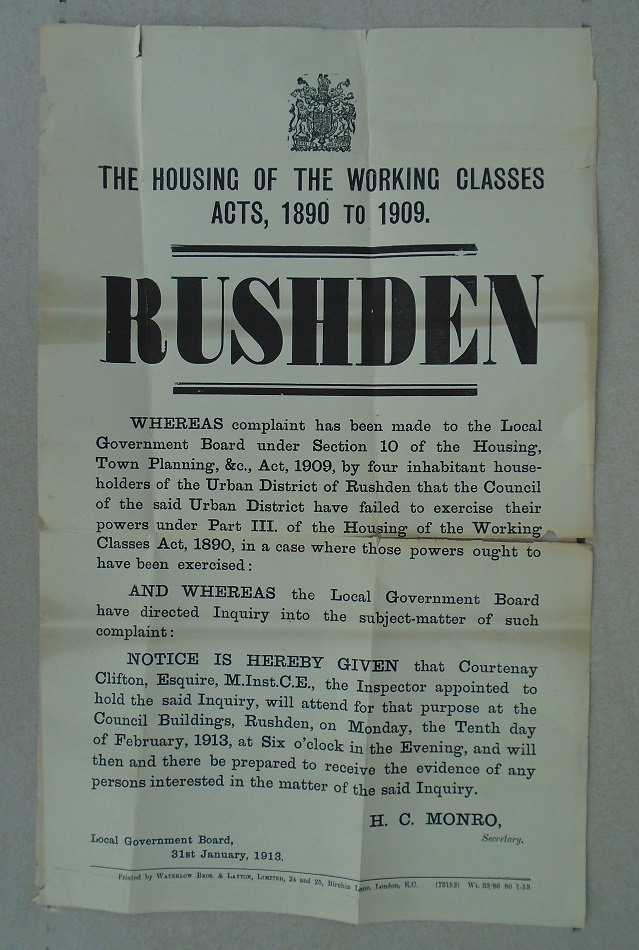
The poster announcing the Inquiry
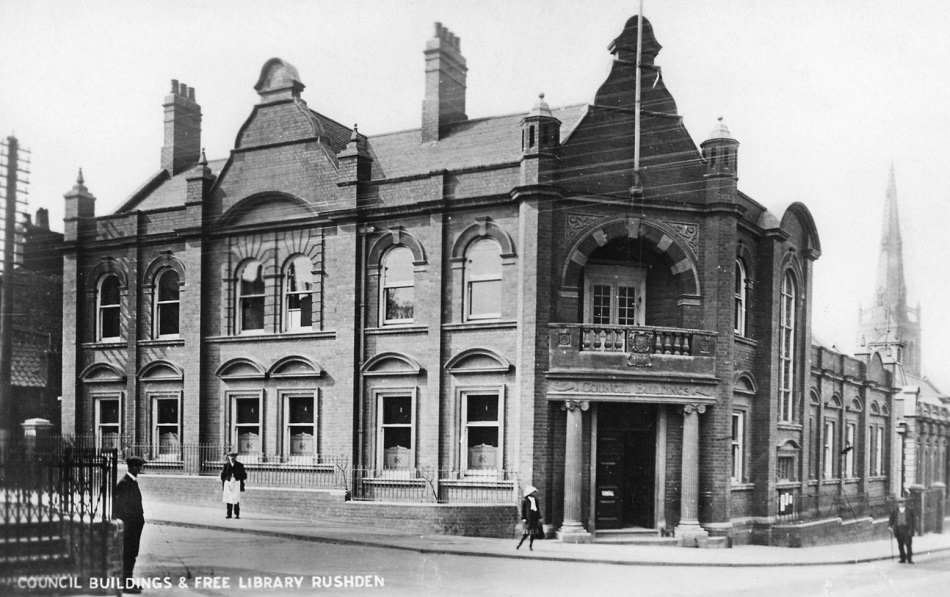
The Council Buildings where the Inquiry was held
Following the Inquiry, in April 1913 Rushden Urban District Council was ordered to build 30 houses. 15 were to be built to let at 5/6 per week, and the remaining 15 at 4/- a week. It was also suggested that provision of a bath in the higher priced houses would be desirable.
By July 1913 the plans for these houses were ready, but it wasn’t until February 1914 that an agreement was reached. The agreement was – To erect 28 houses of the Class A type (all semi-detached) at a cost of £206/5/0 each, to be let at a weekly rental of 5/9, the tenants paying in addition the water charges for the baths amounting to 1/3 per quarter.
To erect 12 houses of the Class C type at a cost of £171/5/0 each, to be let at a weekly rent of 4/9 each.
Tenders were accepted from Mr. Robert Marriott for the 28 class A houses, and from Mr. W. Thompson for 12 type C houses.
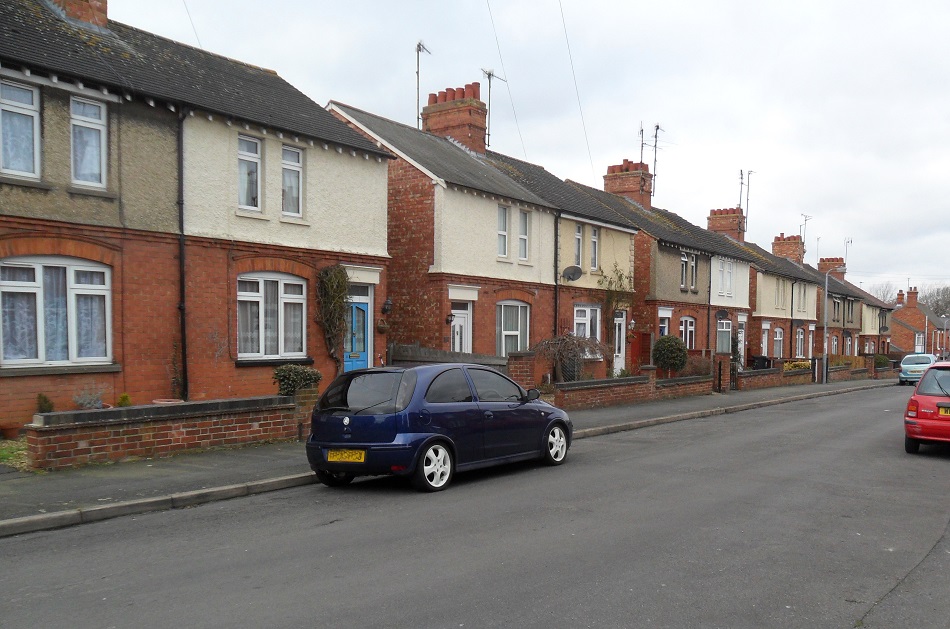
Type A houses in what was named Kings Road
In February 1915 tenants were selected for the first eight houses of the Class A type and four of the Class C type houses. Progress with the building was very slow and in August it was stated that the first four houses would not be finished until the end of September. At the council meeting on the 8 December 1915 it was announced that tenants had been selected for the remaining houses which would be ready for occupation by 18 December.
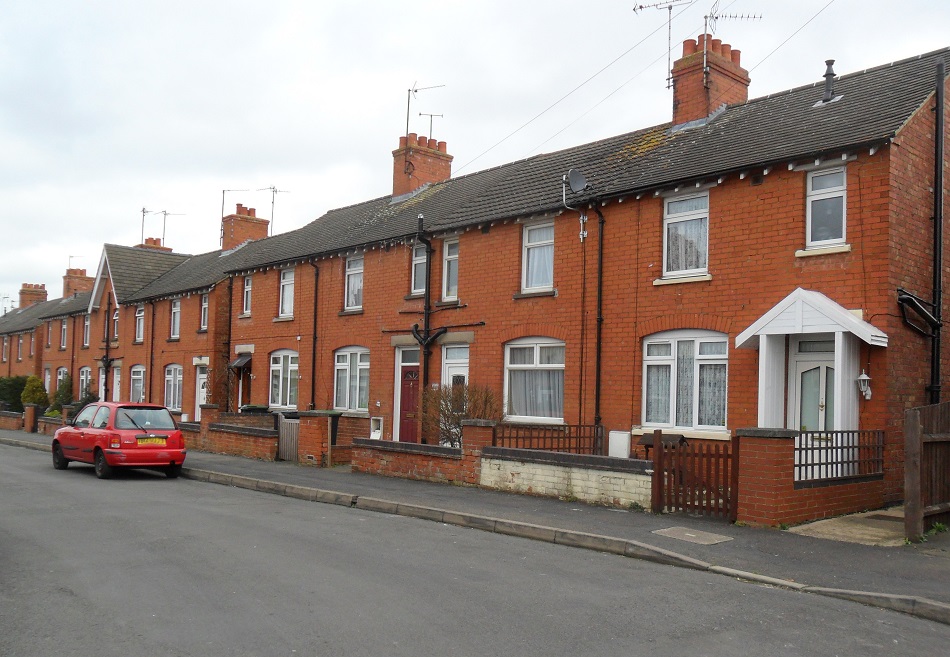
Type C houses in Kings Road
Forty-one houses were built in 1914 but then came WWI which prevented much building. However, following the war building continued and by 1924 over 200 more houses had been built on the Newton Road Estate and the Irchester Road Estate. By March 1933, when Councillor L. Perkins, M.B.E. presented a report on the Housing Schemes, 602 houses had been built by Rushden Urban District Council.

Councillor L. Perkins, M.B.E.

Trafford Road built 1923-4 part of the Newton Road Estate

Irchester Road built c1926

Tennyson Road built c1926
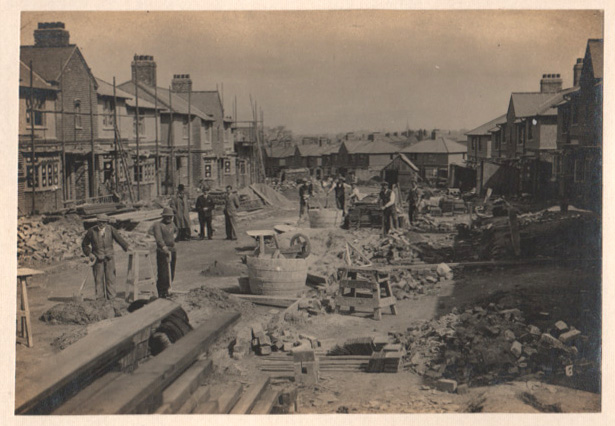
Westfield Avenue under construction c1925-6

Westfield Avenue in 2023