

In the early 1920s the Rushden Echo published a series of articles by Dr. Charles Fisher about the history of Rushden. These articles covered numerous subjects, one of which was ‘Farms.’ In this section Dr. Fisher first mentions Washbrook which runs through Spencer Park in Washbrook Road. He remembered playing truant from Mr. Knight’s school to watch the sheep being thrown into the water and the wool rubbed over with a rubber, a piece of wood at the end of a long handle, before the sheep-shearing season.

A sketch of Mr. Knight’s School by Walter Green
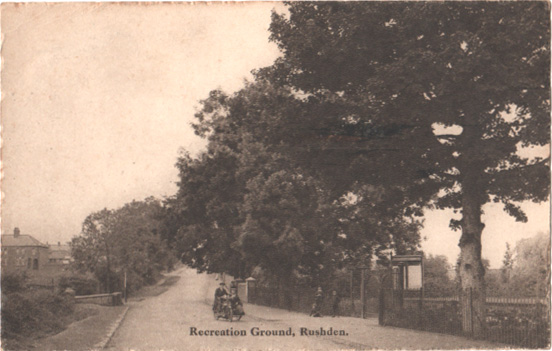
A postcard showing Washbrook Road and the bridge over the brook
Ebenezer Knight was born in Rushden in January 1811, the fifth child of Samual and Hannah Knight. He married Elizabeth Sargeant in June 1830 and they lived in Duck Street. The family were members of the Baptist Top Meeting where from 1857 to 1879 Robert Emms Bradfield was the minister. Ebenezer worked with Mr. Bradfield in his struggles for better conditions for the people, and was one of the founders of the Rushden Temperance Society. He was an educated man and had the ability to teach, so became the teacher at the new independent school, situated on the site of the vestry hall. Walter Green describes him as a thin man of medium height, active, long nose, small keen eyes with spectacles, and standing many hours of the day behind a rickety old desk, with the chastening rod in his hand. A verse repeated by the boys was – “Mr. Knight he’s a very good man, He learns his scholars as much as he can, To read, to write and arithmetic, But he never forgets to give ‘em the stick.”
As the schools were not given any grants or state allowances Mr. Knight’s income was solely from the boys’ weekly pence, so he was often employed by neighbouring farmers to measure land, which consisted of square and cubic measurements which very few were able to grasp.
Once the National School opened in High Street South in 1870 Mr. Knight returned to the shoe trade.
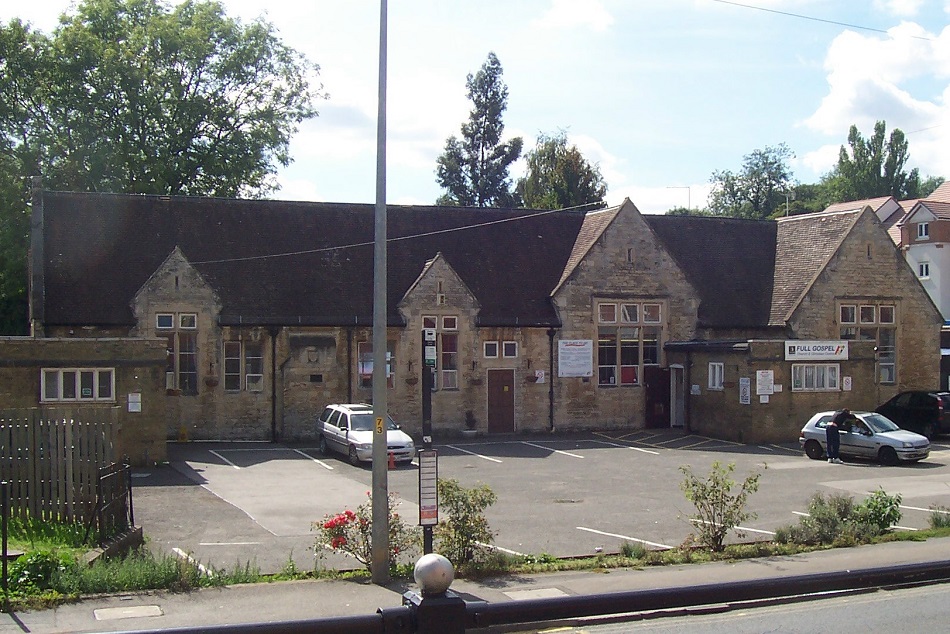
The National School opened in 1870
Dr. Fisher also mentions Higham Park, off Avenue Road, Rushden, which was first attached to Higham Ferrers castle. William the Conqueror granted the land to William Peverel who established a deer park. The Peverel’s eventually forfeited the land. It passed to the King, then to the Ferrers family and then the Duchy of Lancaster. John O’Gaunt went hawking and hunting at Higham Park, bringing with him a small army of huntsmen and servants. There was a farmhouse on the edge of the Park and a shallow moat surrounded it. There was a bakehouse and a brewhouse, about 5,000 gallons of ale being brewed each year.
In the 1800s Higham Park was the home of the Dearlove family. On 8 March, 1880 Mr. Ralph Dearlove was shot dead whilst out on horseback. The Coroner, J. T. Parker Esq., held the inquest at Higham Park with Geo. Perkins (foreman), Thompson Wyldes, John Margetts, Daniel Dickens, William Flawn, Edwin Knight, George Skinner, John Ward, Hy. Smart, William Browning, Alfred Talbutt, Bailey Mortimer, and Richard Rhodes as the jury.

Higham Park in 1910
Mr. Ralph Dearlove, son of the deceased, gave evidence and said he saw his father ride across the fields but he could not see whether he had a gun or not. He confirmed that his father always carried the gun on his left side, and that he had seen him place the gun on the ground on his left side, and put his foot to the mare’s body as a kind of rest for the gun. The matches he used were common lucifer matches, so that he would have been obliged to use both his hands in lighting his pipe.
John Strachan, foreman on the farm, and Thomas Newman, Shepherd on the farm, also gave evidence stating that the deceased was in a cheerful mood when he left to ‘frighten the crows off a field called “Little Black-wells” and that he carried the gun in his left hand.
Evidence was also given by David H. Thomas, a registered surgeon acting as assistant to Dr. Crew of Higham Ferrers. He attended the deceased as Dr. Crew was not at home. Having heard all the evidence he thought it quite possible that the deceased may have been wounded by the gun going off when he leant on one side to put the gun on the ground, or to pick it up.
The Coroner briefly summed up, and the jury returned a verdict of “Accidental death.”
The family did not remain at Higham Park for very long after Ralph’s death, and left following the sale of the farm in March 1881.