
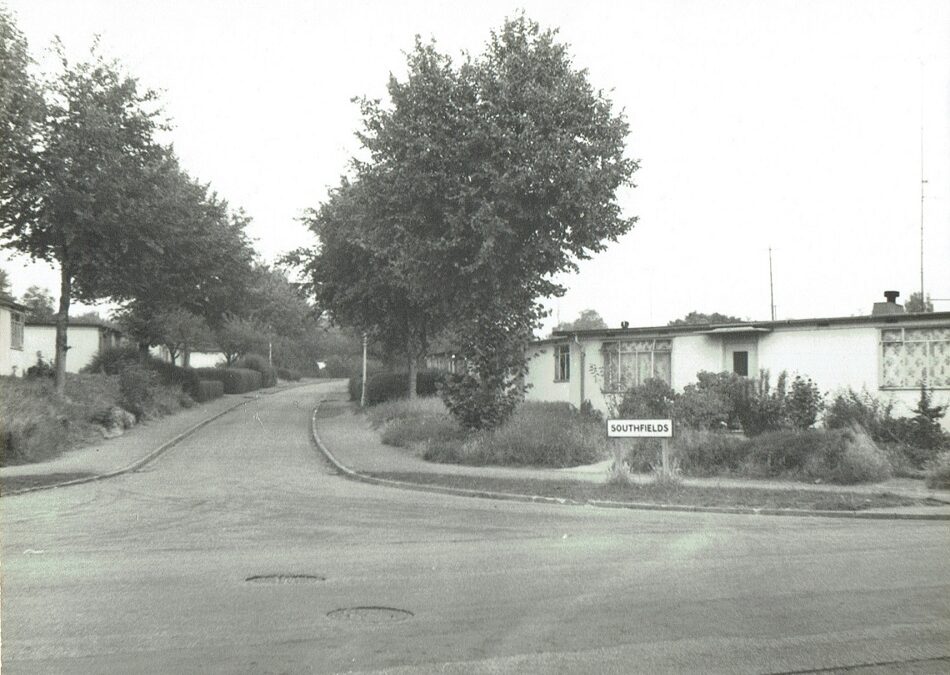
The Housing (Temporary Accommodation) Act 1944 planned to build 300,000 prefab houses in Britain over the following four years. They were intended to last between 10 and 15 years. Just over 150,000 were built, and those in Rushden lasted for nearly 30 years.
There were conflicting views on the temporary houses amongst Rushden councillors, with one member calling them ‘shacks’ and ‘huts.’ However, Rushden needed more houses, especially for servicemen returning from the war, so in spite of not being invited to take part in the scheme by the Ministry of Health, Rushden council decided to approach the government to show the needs of the town.
There was some discussion regarding cost and possible sites but it was decided that nothing could be done until the Ministry said “yes” or “no.”
At the council meeting in January 1945 it was announced that Rushden was to have 50 temporary homes, and possibly more. The Housing Committee recommended the Cemetery Field in Park Road as a suitable site and also recommended that enquiries be made with a view to purchasing a piece of land adjacent, making a total site of about five acres. The Cemetery Field belonged to the council and water was already laid on. There was some objection to the choice of site but the Surveyor, Mr. J. W. Lloyd, pointed out that the Cemetery Field had been laid out for building and if they bought the adjoining land when the land reverted back to ‘open space’ after ten years, they would have double the space they had before. Councillor Allebone favoured the site and thought the people would like the bungalows. He thought that if they were kept nice and not overcrowded it would be difficult to get the people out after ten years.

The shaded area shows the land off Park Road where the prefabs were situated
The extra land was bought for £325 and by June 1945 work on the site was making satisfactory progress. By January 1946 nineteen bungalows were on site but unfortunately, they had no internal fittings and there was no sign of them being delivered.
Things did improve and a month later some had been allocated to tenants, all ex-servicemen, and one of the dwellings was to be open for public inspection on Saturday 23 February. It was opened by Mr. H. Waring, chairman of the Rushden Urban District Council and apparently the ladies who viewed the new home were impressed with the kitchen which was fitted out with cooker, washer and refrigerator.
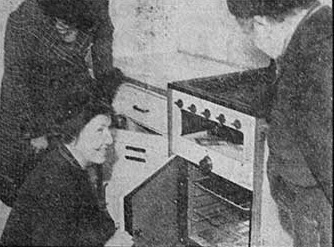
Visitors viewing the cooker in the kitchen of the new home
In 1955 the ownership of the prefabs changed from government to council, and several of the residents applied to buy their homes and brick up the outside but the idea was turned down.
By 1973 the council decided the prefabs had reached the end of their useful life and the residents were to be rehoused. As Mr. Allebone had predicted back in 1945, many of them didn’t want to leave and felt that the council had let them down. The idea of bricking up the outside was again suggested, but Mr. Horsefield, housing manager for Rushden Urban District Council, explained that they would go and see all the residents but that none of the prefabs would be bricked up.