
In August 1914 Rushden’s first bandstand, which had been designed by Mr. W. B. Madin, the town Surveyor, was formally opened in Spencer Park. At 7.00p.m on 20 August the Rushden Temperance, Rifle and Mission Bands assembled on the Green and marched to Spencer Park playing spirited music en route

The Green, on the left of the picture, before the War Memorial was built
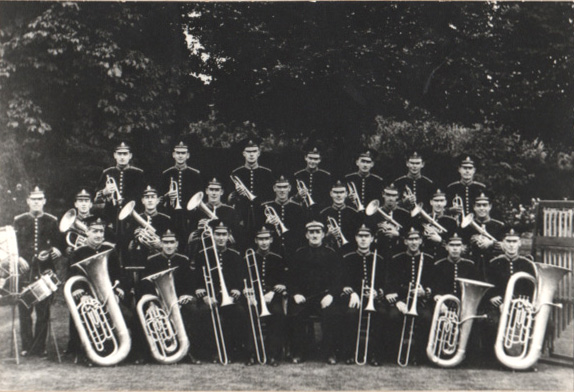
Rushden Temperance Band 1930
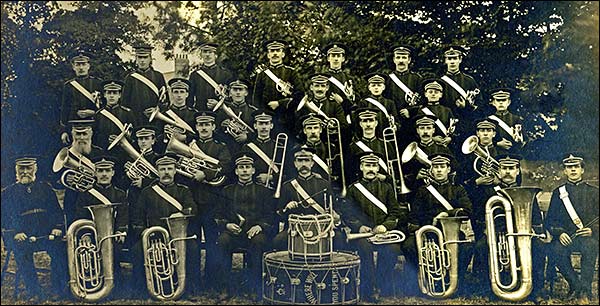
Rushden Mission Band – originally known as the Wesleyan Reform Band
A large crowd gathered round the bandstand and Mr. C. Cross, chairman of the Bandstand Committee unlocked the gate and handed the keys to Mr. J. S. Clipson, J.P., chairman of the Rushden Urban Council, on behalf of the town.
It had been suggested four years previously that Rushden should have a bandstand. A committee was formed and they set to work raising funds but the difficulty was finding a suitable site. The only one available at the time was the council field in Park Road, so for a time the matter was dropped, but then the council opened the Spencer Park Recreation Ground. The committee set to work again and soon raised over £50. On handing over the keys Mr. Cross asked the Chairman of the Council to accept the bandstand for the use of the bands and choirs of the town.
.
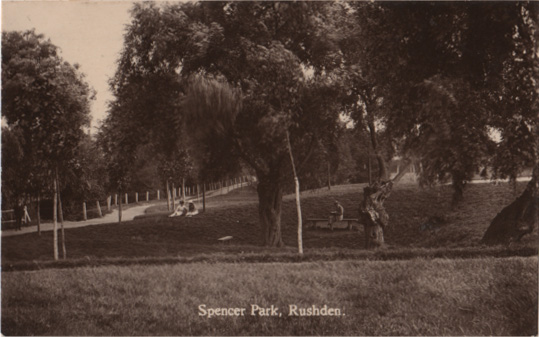
Spencer Park
By Easter 1926 trouble was brewing between the Council and the bands. Before the stand was built the bands were asked to choose a suitable site. They chose a site under the trees (roughly where the paddling pool was) but the Council decided that water dripping from the trees would rot the wood, so it was built in the open. Naturally that meant it was exposed to all the weather and the wood rotted, or so the bandsmen said. The bandsmen were complaining that it was ‘an apology for a bandstand’ and they often had to sit with the sun on the backs of their necks making them feel ill. The Council was not prepared to provide a new bandstand or to put a roof on the existing one, unless the bands contributed most of the money, which they couldn’t do. There were also arguments over who should arrange the fixtures. The meeting ended with a resolution, unanimously carried, that the bands had no objection to out-of-town bands coming to give concerts from the bandstand, but all the Rushden bands refusing to give concerts in the Park until the Council gave a definite promise to provide a proper cover on the stand. It was further agreed that the Council delegation be informed that the bandsmen would be prepared to meet them on Tuesday 1 June.
Further meetings did not resolve the matter. The bands continued to play in Spencer Park but did not use the bandstand. The Council inspected the stand and decided it was in as good a condition as when it was erected. The Parks Committee were unable to recommend the Council to provide a new bandstand and it was impossible to provide a cover for the existing one. Eventually the bandsmen met with the Emergency Committee of Rushden Council. The meeting lasted only a few minutes but ended with the bandsmen being satisfied both with the tone of the meeting and the promise made by the Committee, so the concerts could continue.
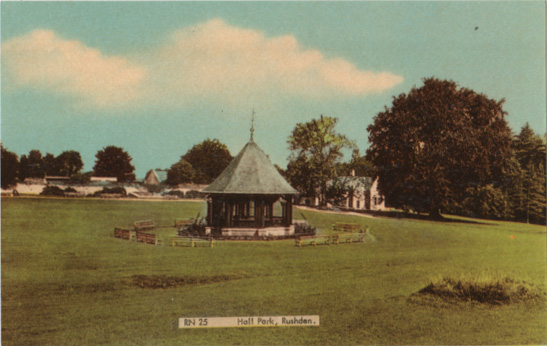
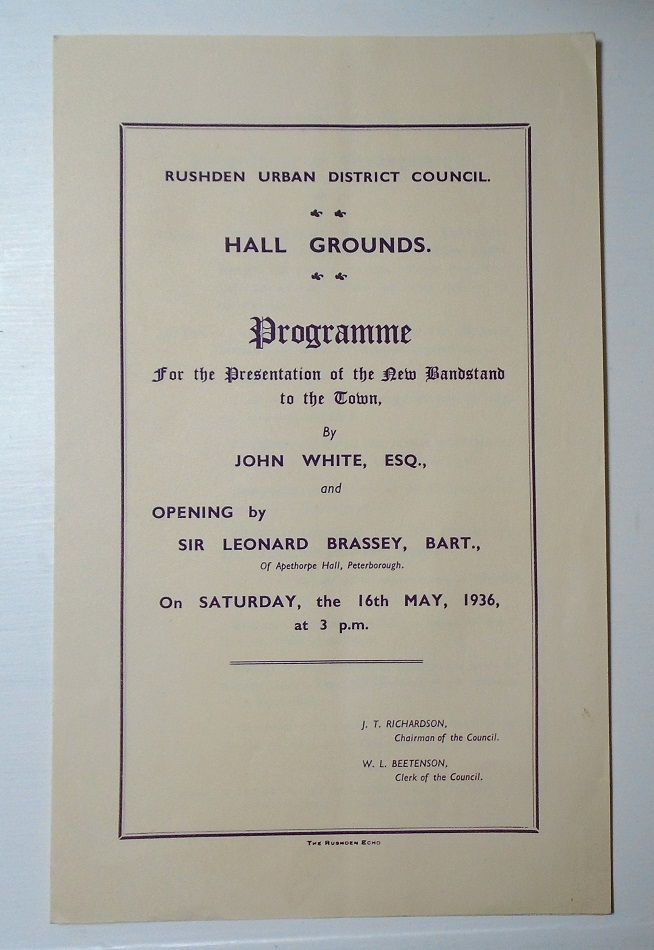
In 1930 Hall Park was opened and in June 1935 the Council received a letter signed by the Hon. Secretaries of the various bands of the town, stating that an interested gentleman had offered to provide, subject to certain conditions, a bandstand in the Hall grounds to celebrate the Silver Jubilee of Their Majesties King George V and Queen Mary. The Clerk was instructed to convey thanks to the donor, and a special committee was to be appointed to confer with the donor and representatives of the bands on one or two points contained in the offer. The gentleman concerned was Mr. John White and he later agreed to bear the extra expense of a paved surround as it was thought the turf would be worn away.
The new bandstand was opened in May 1936 and was inscribed “Erected to commemorate the Silver Jubilee of the reign of His Majesty King George the Fifth 1935. The gift of Councillor John White 1936.”
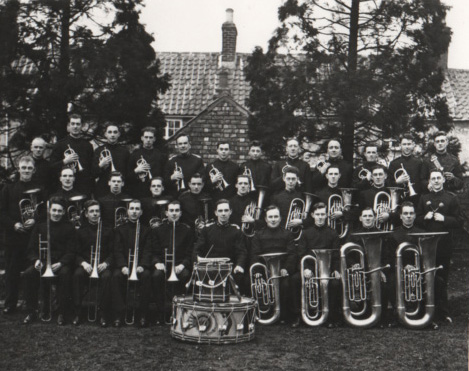
Salvation Army Band 1930
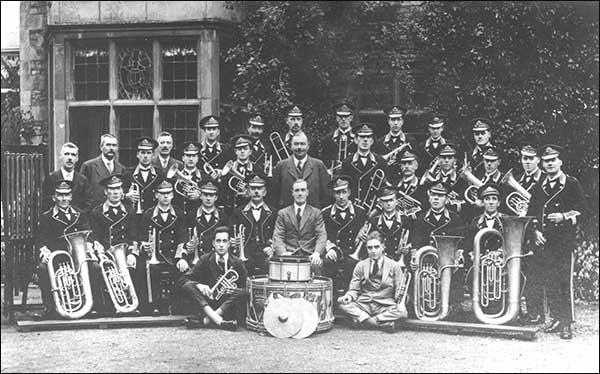
Rushden Town Band 1925
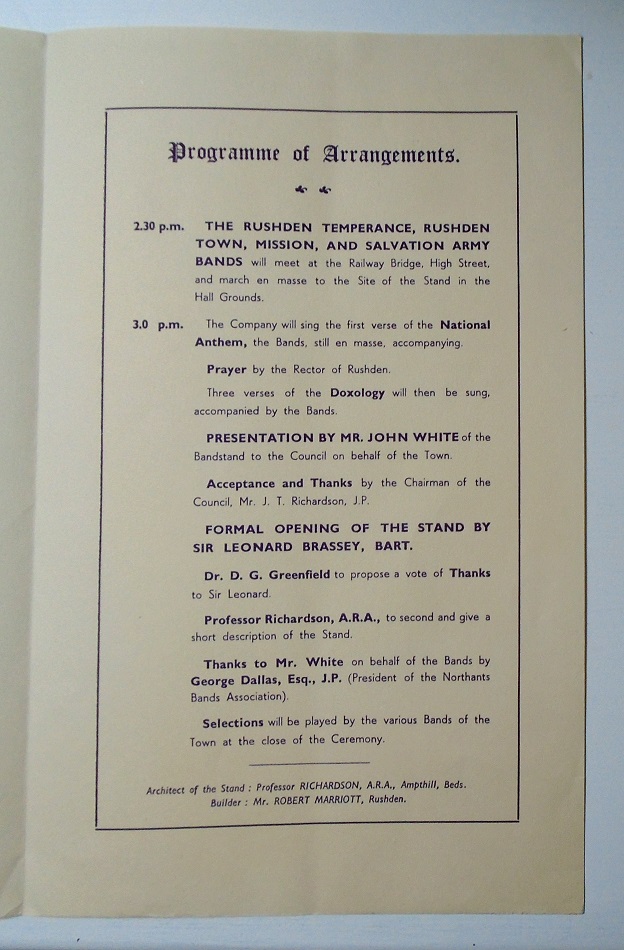
After meeting at Station Approach, four bands of the town (Temperance, Town, Mission and Salvation Army) played through the High Street to the Hall Park. The Chairman of the Council, Mr. J. T. Richardson, welcomed Mr. John White who declined to make a speech but asked Councillor Richardson to accept the bandstand on behalf of the town. It was formally opened by Sir Leonard Brassey who made an entertaining speech, concluding by saying that he had promised to give the architect, an old friend of his, an honest opinion of the design of the bandstand. He said “of all the bandstands I have ever seen, I have never seen one which fits so charmingly into its surroundings. It is dignified, built of county materials………………. I cannot imagine in these dignified surroundings any bandsman playing a wrong note or coming in when he isn’t wanted. It is very charming.” He then declared the bandstand open.
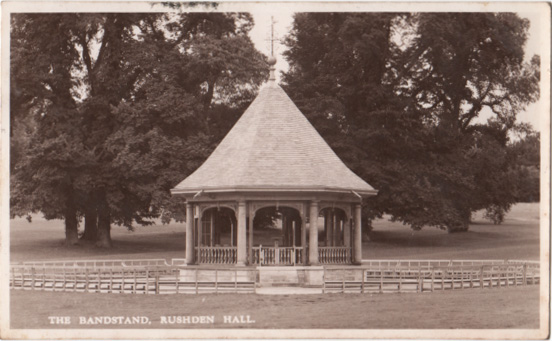
The bandstand in Hall Park
The architect, Professor Richardson, told a reporter from the Rushden Echo and Argus that the stand was of a unique design, resting on a base of Ketton stone and for the main part built of English oak. Massive oaken pillars supported a conical roof which was covered with Stamford tiles and surmounted with a handsome weather vane. The ceiling was of teak, and other features were the folding and sliding weather screens, a fine conductor’s rostrum, an up-to-date and almost hidden system of electric lighting and the old-style ornamental rain pipes.
It was built by Robert Marriott at a cost of about £2,000
The bandstand was later refurbished and then rebuilt in the 1980s.
Sadly it was burnt down by vandals in 1997.
In 2013 the base was converted into a Rose Arbour to mark the Diamond Jubilee of Queen Elizabeth II. and concerts are now held in the Walled Garden in Hall Park.
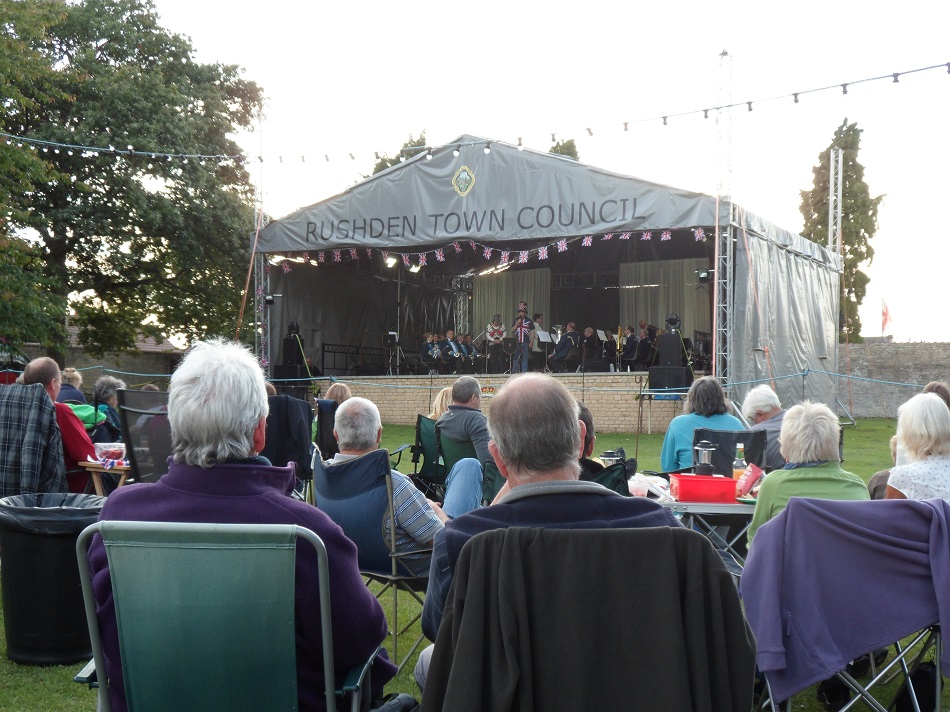
A concert in the Walled Garden