
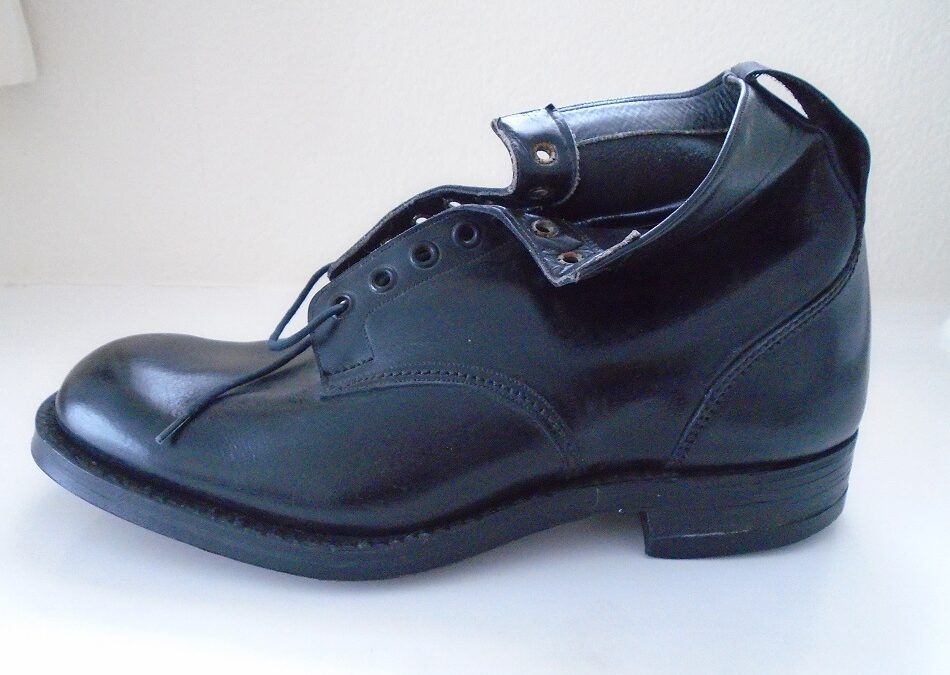
Going through some boot and shoe material recently bequeathed to us at Rushden Museum I came across a letter, dated October 1898, from Mr. J. Wykes Ashdowne, manager of the Northamptonshire Union Bank in High Street, Rushden to Mr. W. Abrams in Co-operative Row. Mr. William Abrams had stood as one of 31 guarantors for the Rushden Boot Company which had presumably failed leaving £158/3/9 owing to the bank. Mr. Abrams share was £5/2/- which in today’s value would be nearly £850. A good chunk of money now but in 1898 when most people had nothing and the average wage for men was less than £1 a week, it must have been a scary amount.
The letter from the bank is dated 26 October and asks for payment by 31 October so no pressure.
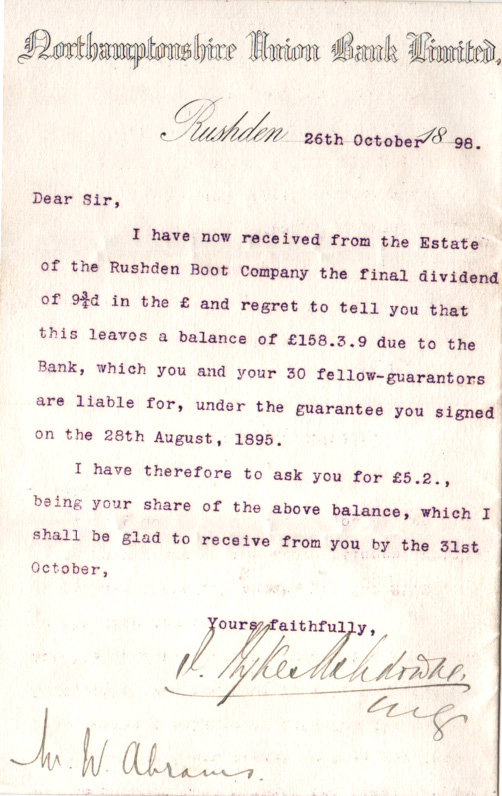
The letter from the bank

The Northamptonshire Union Bank

The envelope addressed to Mr. W. Abrams
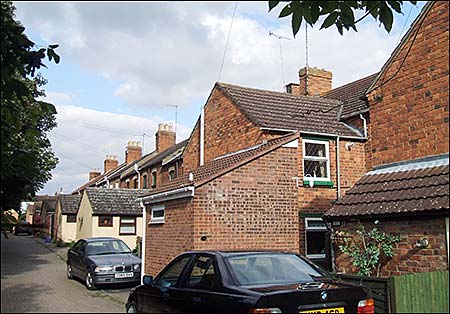
Co-operative Row, Rushden
I found no mention of it in the Rushden Echo for 1898, although there were two other bankruptcies in the boot and shoe industry. In April 1898 George Frederick Brown, boot manufacturer trading as Brown & Son, and in December 1898 Barratt & Barratt with a deficiency of £2,015.
The case of Brown & Son came up at the Northampton Bankruptcy Court in May 1898 when there were liabilities of £1,131,
George Frederick Brown, who set up the business with his father in1894 when he was 18 years old, had a factory in Rectory Road. His father left the business in December 1896 because the worry was too much for him.
In January 1898 a serious fire broke out in the factory. It started in the packing room on the second floor, and was discovered soon after 6.30 p.m. The alarm was raised by ringing the church bell, and as a crowd soon gathered they were able to remove a large quantity of stock, under the supervision of the police, before the fire brigade arrived. Once the brigade arrived, in the charge of Captain Fred Knight, the fire was soon under control, and within an hour of the alarm being raised the fire was out. Damage was extensive and estimated at hundreds of pounds, but both building and contents were insured.
The business had apparently never been successful but the fire was the final straw.
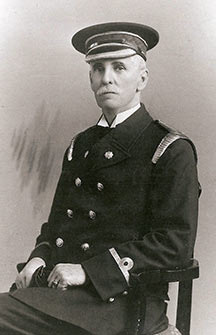
Captain Fred Knight

A sketch of the fire from the Rushden Echo