
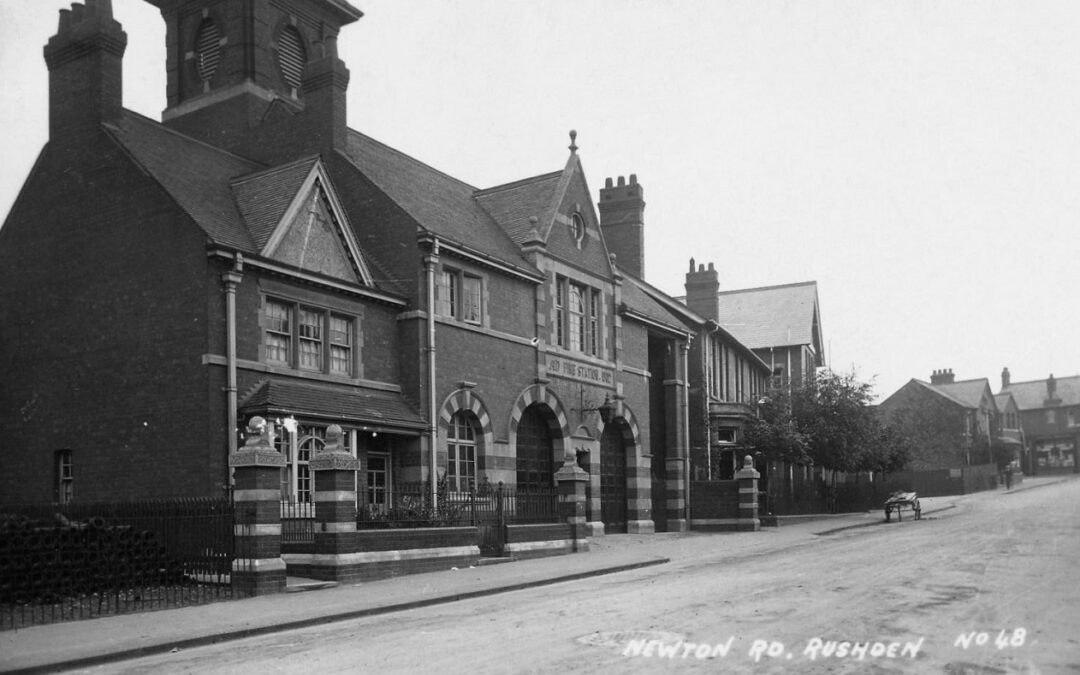
At the beginning of March 1927 the Rushden Urban District Council received letters from the Secretary of the Fire Brigade asking the Council to consider the purchase of an additional motor pump, and also the making of arrangements with outlying towns and villages for the payment of a retaining fee to the Council for the use of their fire appliances. A deputation from the Brigade was asked to attend the next Council meeting.
By May 1927 demonstrations had been held with two makes of motor fire-pumps and the Brigade recommended that the “Dennis” be purchased, at the price of £810 net. Other equipment would be required at a cost of £78 2s. The Council agreed to this and decided to apply to the Ministry of Health for sanction to borrow £920 for the purchase of the motor-pump.

A Dennis Ace Fire Engine
On the 20 May, 1927 the Rushden Echo carried an article giving details of the pump and the demonstration which had been held in Home Close and watched by many Rushden people. Several lengths of hose were laid, covering hundreds of yards or more uphill in the field, and the water from an inch jet was easily thrown from the nozzle some 80 or more feet. The force of the water was seen in the way in which it broke away small branches of the tree in Home Close.

These cottages were were known as Home Close Cottages and stood on the site which is now Orbit Tyre Co. Ltd. The field was behind the cottages.
Tests were made with various sizes of jets, and all were regarded by the Brigade Officers and ex-Brigade members as highly satisfactory. Six jets could be used at once, all with sufficient throw for a four-storeyed building. The Dennis motor fire-engine was regarded by the Rushden officials who watched the test as being well capable of meeting all the needs of the town and district.
Captain A. Sudborough of the Higham Ferrers Fire Brigade also attended the demonstration.
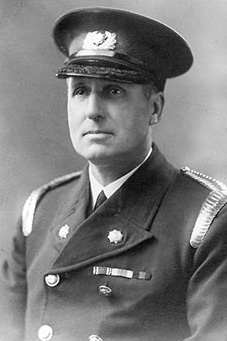
Robert Knight was captain of the Rushden Fire Brigade from 1919 to 1936
The article in the Rushden Echo also gave details of the engine.
“The engine develops 33 to 36 horse-power, the petrol tank holding ten gallons. The water circulation is assured by gear-driven pump and by-pass from the main pump, the overflow being fitted under the radiator. As the motor is driven along the road it is capable of a speed of 33 miles per hour along the level and will climb a one-in-six hill with full load. The pump is provided with two delivery outlet fittings and adapters to suit standard hose couplings as used by the Brigade. The output is 225 gallons per minute at 120lb. pressure per square inch, and up to 350 gallons per minute at lower pressures.”

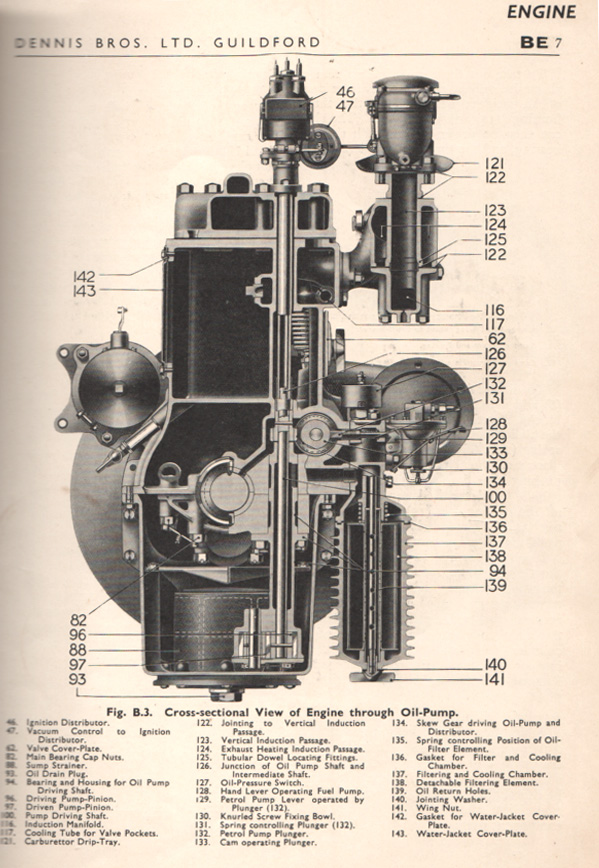
Details of the engine in the Instruction Book

Details of the engine in the Instruction Book
Hopefully, the new motor pump was in service by August 1927 when fire broke out at the factory of Messrs. Palmer and Surridge in Wentworth Road, Rushden. When work ceased for the dinner hour everything seemed to be all right, but within a few minutes workers going home from other factories noticed volumes of smoke coming from the street windows on the second storey. They went into the building and found some of the employees trying to get into the office where the seat of the fire was. The brigade was called and were on the scene in a few minutes with the tender being driven by Captain Robert Knight. In spite of the efforts of the firemen most of the floor was burnt out before the flames could be put out. The third storey was also badly damaged. Most of the work on the premises was spoilt, but it was said to be insured.
The brigade stayed on into the middle of the afternoon to make certain there would be no further outbreak. The large crowd who had gathered were controlled by a number of police constables under Inspector Knight, Sergt. Roughton and Sergt. Cherry.