

On the 21 December 1914 Mr. Edward Campbell Browning, M.A., J.P., of Rushden House, died suddenly. He had been out for his usual walk after lunch and on returning home he complained of feeling unwell. He passed away peacefully in his sleep a short time after, and although Dr. Kesteven (locum for Dr. Greenfield), Dr. Owen and Dr. Crew were called there was nothing they could do. He was 78 years old, and left a widow and one son, Mr. Robert Campbell Browning.
His death came very soon after that of his son, Major James Alexander Browning of the 2nd Dragoon Guards (Queen’s Bays), who was killed in action on the 31 October 1914.
In1901 the family were living in Knuston Hall and moved to Rushden House shortly after.
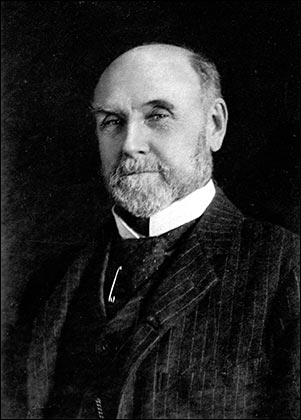
Mr. Edward Campbell Browning, M.A. J.P.

Major James Alexander Browning
Rushden House was built in 1870 and was originally the home of Henry and Flora Currie. When they first came to Rushden they lived in the The Cottage which later became the home of John Cave and his family. Henry Currie died in July 1900 aged 72, and Flora in October 1901 aged 65. At the end of September 1902, in the Public Hall, Rushden House came up for auction. It was described as having pleasure grounds, green-houses, stabling, coach house, cow houses, servants’ cottages, garden, orchard, and paddock, 24 acres of pasture or building land, and five messuages. Mr. Pendered first offered lots 1-3 in one lot. Lot one comprised the mansion known as “Rushden House,” with outbuildings, servants’ cottages, gardens, and orchards, the whole being six acres, two roods, twelve poles in extent. Lot 2 was the close of pasture or building land known as “Crofts,” which, with lot three, was in the occupation of Mr. C. E. Knight, at a yearly rent of £40. “Brown’s Close,” forming lot three, brought a rental of £40. The bidding for the combined lots started at £4,000, advancing to £5,000, at which figure they were withdrawn. Lot one being offered separately, bidding started at £3,000, going to £3,300, and being then withdrawn. Lots two and three each failed to obtain a bid.
Lot four consisted of three dwelling houses in High Street South, known as “Rose Hill,” let at a gross annual rental of £42 6s. Bidding started at £300, and the lot was withdrawn at £440.

Rushden House

Rose Hill
Following the death of Mr. Browning the house was purchased by Mr. George Henry Lane in 1915. He was a leather merchant from Kettering and he never lived in Rushden House.
In 1916 an agreement was made with the government to allow part of the house to be used as a prisoner of war camp. German prisoners slept above the old stables and would go out daily to local farms with military guards and were put to work to help the war effort. Repatriation came with the end of the war, but the camp was still operating in September 1919.
When the County Council were looking for a suitable sanatorium in 1919 they considered the purchase of Rushden House. The number of cases of Tuberculosis was increasing especially amongst workers in the shoe trade, and when Dr. Baker, the Medical Officer of Health for Rushden, produced his report for 1918 it showed that there were 60 cases of Tuberculosis reported in Rushden with 24 deaths. The Rushden Urban District Council received a letter from the Ministry of Health assuring them that a properly run Sanatorium would present no risk to the people of the town. Some of the councillors were against it, and they all thought that they should have been asked to give an opinion on the matter.
At a meeting of the County Council in January 1920, Mr. Claridge spoke against the proposal. He thought that the soil was altogether unsuitable, the site was near the main road, there was a large elementary school nearby, where 400 or 500 children were educated, and many of the people in the town felt it was not a suitable place for a Sanatorium. As the building had already been purchased Mr. Claridge thought it should be used for other purposes.
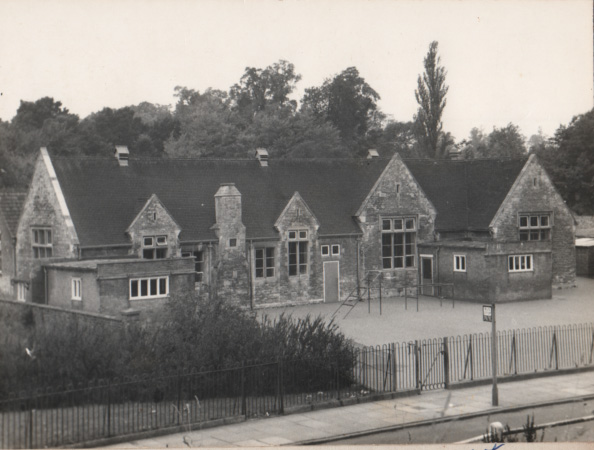
South End School which was not far from the Sanatorium
Also speaking at the meeting, Mr. A. Webb (chairman of the committee) explained, with regard to Rushden House, that the 66 beds at £300 a bed would cost about £20,000, of which the Government would pay £11,880, leaving the County Council to provide £8,120. Of the latter sum the Government would contribute in maintenance grant 50 per cent., leaving the County Council to find about £4,000. Allowing a margin, the sanatorium, which would be a credit to the county, would cost only a rate of about three-farthings in the £. It would be the wish of the committee to make the sanatorium as homely and comfortable as possible. The surroundings were all that could be desired. The land was well timbered; there was a good floor for light recreation; there was a very large kitchen garden, where, he hoped, the patients would be able to put in a certain amount of light work which would be a benefit to them; there was a big orchard, and everything which a sanatorium required.
Despite all the objections the project went ahead and by September 1921 the first patients had been admitted. The matron was Miss B. C . Allsop, and the resident medical officer was Dr. J. H. Crane B.A., M.D., B.Ch., B.A.O. At that time there were 14 patients, mostly men, being treated. There was accommodation for 68 patients and it was hoped the Sanatorium would be full by the Christmas.

Rushden Hospital
The treatment for Tuberculosis improved and the number of cases declined and by 1960 it became known as Rushden Hospital. In 1958 a Skin Unit had been opened in the House, and in 1968 a ward was opened for disabled children. By 1975 the Rushden House Day Hospital was opened for Psycho Geriatric patients sent by the local G.P.s. This was known as ‘Cordwainers.’
As with a lot of local facilities the hospital was eventually closed and the outbuildings demolished in 2014. The site has been given over to housing and Rushden House converted into apartments.