

On the 4 July 1901 the Mission Chapel in Wellingborough Road, Rushden, was opened with the first sermon preached by the Rev. J. G. Greenhough of Leicester, president of the National Federation of the Evangelical Free Churches. The building was erected by the Independent Wesleyans and comprised an assembly hall with gallery round the sides and front end, a lecture room, five classrooms, cloakroom, lavatory etc. The Hall and gallery could seat 450 people and by opening the folding doors to the classrooms the number could be increased by 50.

The Mission Chapel, Wellingborough Road, Rushden
The building cost £2,272, the architect being Mr. Wills of Derby and the builder Mr. Henson of Wellingborough. The site cost an additional £377, heating £100, seating £60, and fencing round the property £30. Prior to the opening service the Mission Silver Band played in the streets.
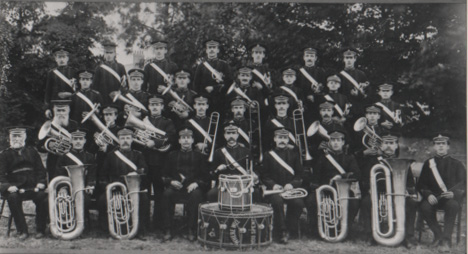
The Mission Silver Band c1911
The 19 July, 1901 saw one of the biggest disasters to hit Rushden, when the boot factory belonging to Messrs. John Cave & Sons went up in flames. The factory was situated in the High Street and extended back to Alfred Street. It was very modern for it’s time and was equipped with all the latest machinery. There were also shops at ground level fronting on to the High Street.
The fire started at lunch time when the workers had all gone home and in an amazingly short time the whole building was engulfed in flames. The intense heat caused the fire to spread across Alfred Street to the school, the headmaster’s house, and several adjoining houses in Alfred Street. In the High Street the row of shops opposite the factory were thatched and so stood little chance of survival. Sadly they were all destroyed. At that time Rushden’s water supply was totally inadequate and although brigades from Higham Ferrers, Irthlingborough, and Wellingborough came to assist there was little the firemen could do. Kettering and Northampton brigades declined to come owing to the shortage of water.
The damage was estimated at between £70,000 and £80,000 and about 800 employees lost their jobs.
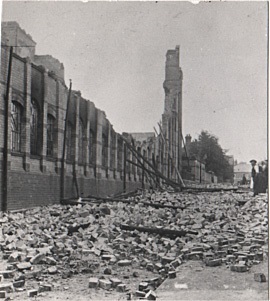
Alfred Street covered in rubble
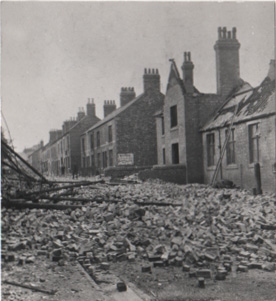
Alfred Street School, and the headmaster’s house
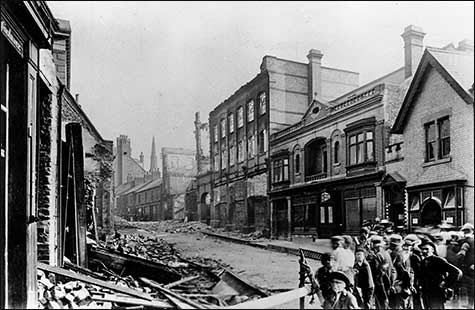
The High Street after the fire

A much earlier photo of the High Street showing Cave’s first factory, which was also destroyed by fire in 1877, and the row of shops on the left of the picture which were destroyed in the 1901 fire.
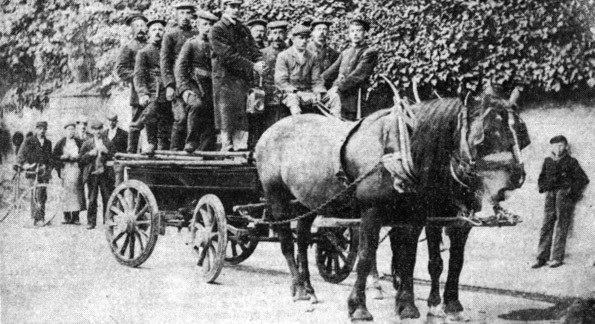
The Higham Ferrers brigade heading home after the fire
On the 5 July 1907 it was reported in the Rushden Echo that Rushden Urban District Council had purchased a new steam fire engine for the use of the Rushden volunteer Fire brigade. It was tested on a Saturday afternoon in front of a large crowd, and proved very satisfactory. Made by Messrs. Shand, Mason & Co., and used by fire brigades all over the country, the engine was very efficient. It could be lighted on leaving the station or at any point en route to the fire, without stopping. The engine was mounted on strong, high, wood spoke wheels, with steel axles, springs, and side frame. It had a full sized hose box, the lid of which formed a seat for the firemen. Even when fully loaded it could easily be drawn by a pair of horses, or for a nearby fire it could be dragged by hand.
It had a capacity of 300 gallons per minute and would throw a 1 1/16 inch jet to a height of 150 feet.
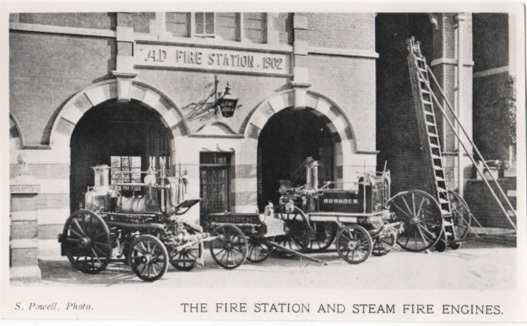
The steam engine referred to is the one on the right