
According to a notice in the Wellingborough News, in 1878 the population of Rushden was rapidly increasing with twins frequently being born, and in June of that year it was reported that Mrs. Ebenezer Claridge had given birth to triplets – 2 boys and a girl. Following an application by Rev. J. T. Barker, Her Majesty the Queen directed the Keeper of the Privy Purse to forward £3 to Mrs. Claridge.
Ebenezer Claridge was a boot manufacturer, with a factory in Rectory Road, and by 1901 the Claridge family were living in Hayway in the house which was to become Rushden’s Memorial Hospital.
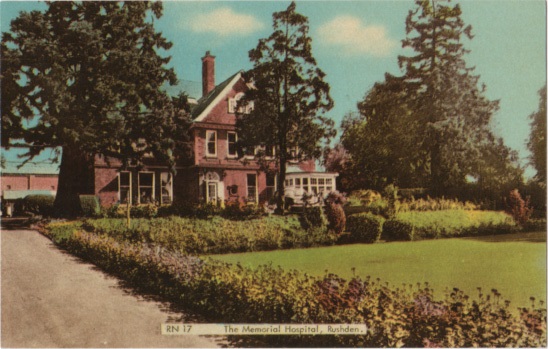
Rushden Memorial Hospital formerly the home of the Claridge family
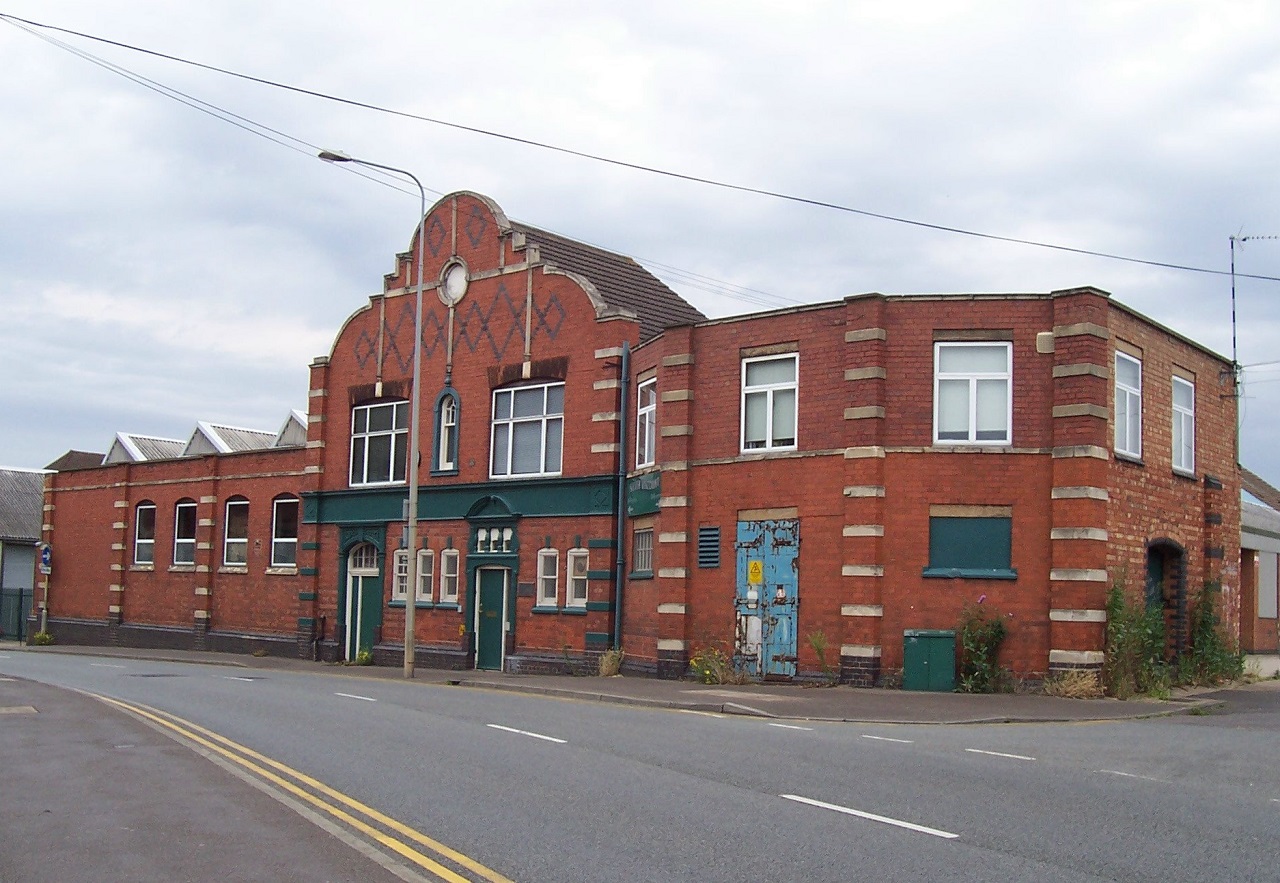
The factory of Ebenezer Claridge and Sons in Rectory Road, Rushden
June 1887 saw the Golden Jubilee of Queen Victoria but the celebrations in Rushden seem to have been very low key. The day started with peals of bells and there were two arches across the road near the church, but apart from a few flags displayed by residents there doesn’t seem to have been much in the way of decoration. Two teas were provided – one for children and one for ‘old folk.’ 1,500 children met at the various schools and were then taken round the town to their destinations. 500 infants were in the Public Hall and the adjoining school room, and 1,000 were taken to Mr. Skinner’s Home Close for tea in the open air. 250 ‘old folk’ sat down to tea in the Public Hall and Home Close.
Other residents, not being included in these events, took themselves off to Bedford, Wellingborough or Northampton. Residents of Drawbridge Place, near Succoth chapel, organised their own celebrations, as did about 40 residents of Newton Road who enjoyed an al fresco meal in a field near Mr. Mortimer’s Lodge.
The landlords of the New Inn (later the Railway), Waggon and Horses, Wheatsheaf and the Rose and Crown also organised their own inducements to their customers.
After the Children’s tea, games were arranged by Messrs. Wood, Vann & Wilby, and the whole event was finished off with a display of fireworks at dusk.

The arches across the bottom of Newton Road
In June 1889 the Rushden Cricket and Football ground was opened. It was situated on Newton Road, about 5 acres, and enclosed on three sides by hoarding 6 feet high. A ‘very handsome’ pavilion was erected, the gift of Mr. Campbell Praed. The work was carried out by Messrs. Freeman, at a cost of about £400. The dressing rooms and refreshment bar were situated on the ground floor, and on the first floor, approached by a number of steps, was a luncheon room, complete with balcony, capable of seating a large number of people. The architects were Messrs. Talbot, Brown, and Fisher, of Wellingborough. The ground was let at a pepper-corn rent by Mr. H. Sartoris, J.P., of Weekley, son of Mr. F. U. Sartoris of Rushden Hall.
The match on the opening day was between the Rushden Cricket Club and an eleven of the Northampton Club and Ground (captained by Mr. J. P. Kingston). The attendance, although it improved as the day went on, was not as good as might have been expected owing to the fact that it was the day the shoe workers started back to work after the holidays.
Sadly, the pavilion was destroyed by fire in December, 2000.

A Rushden Cricket team outside the pavilion
One of the most important events that happened in Rushden around that time was the Northamptonshire Agricultural Show. It came to Rushden in June 1898 and was held in a field in Wymington Road. Preparations had gone on for weeks before and local shopkeepers along High Street South and High Street decorated their shop fronts. Several of the local traders had stands in the exhibition, and there were exhibitions of cattle, horses, sheep and poultry. Owing to swine fever there were no pigs.
Extra trains were run with cheap excursion tickets to bring people to the show and most of the factories in the town closed for half a day so the workers could attend. More than 12,000 entered the show ground over the two days, breaking previous records.
As with most events at that time, the whole event was rounded off with a fireworks display, supplied by Messrs. Wilder & Co., of Birmingham.
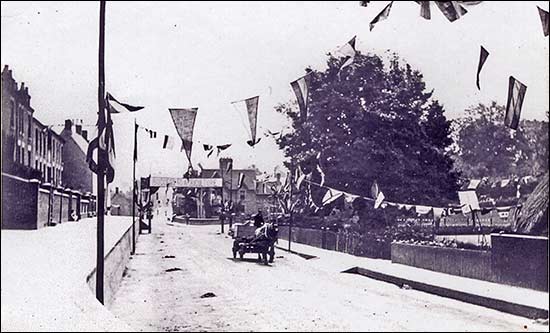
High Street South decorated for the Agricultural Show