
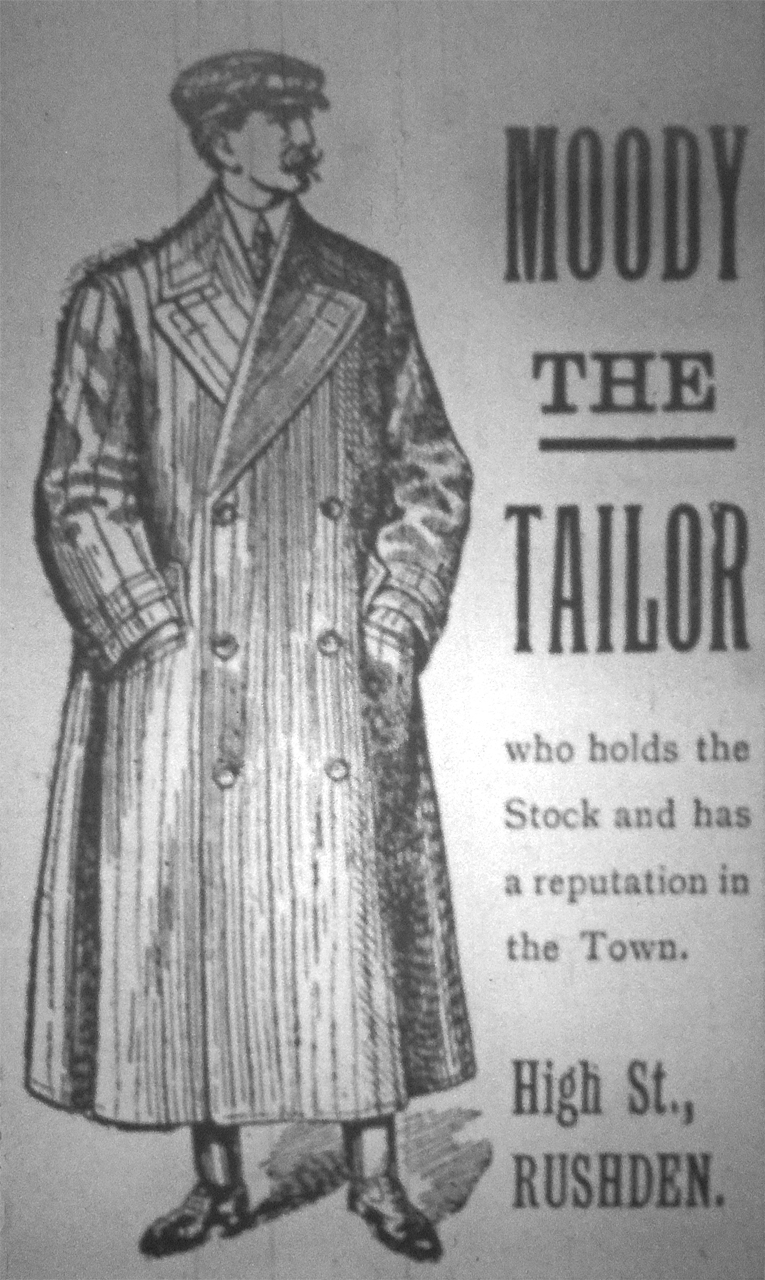
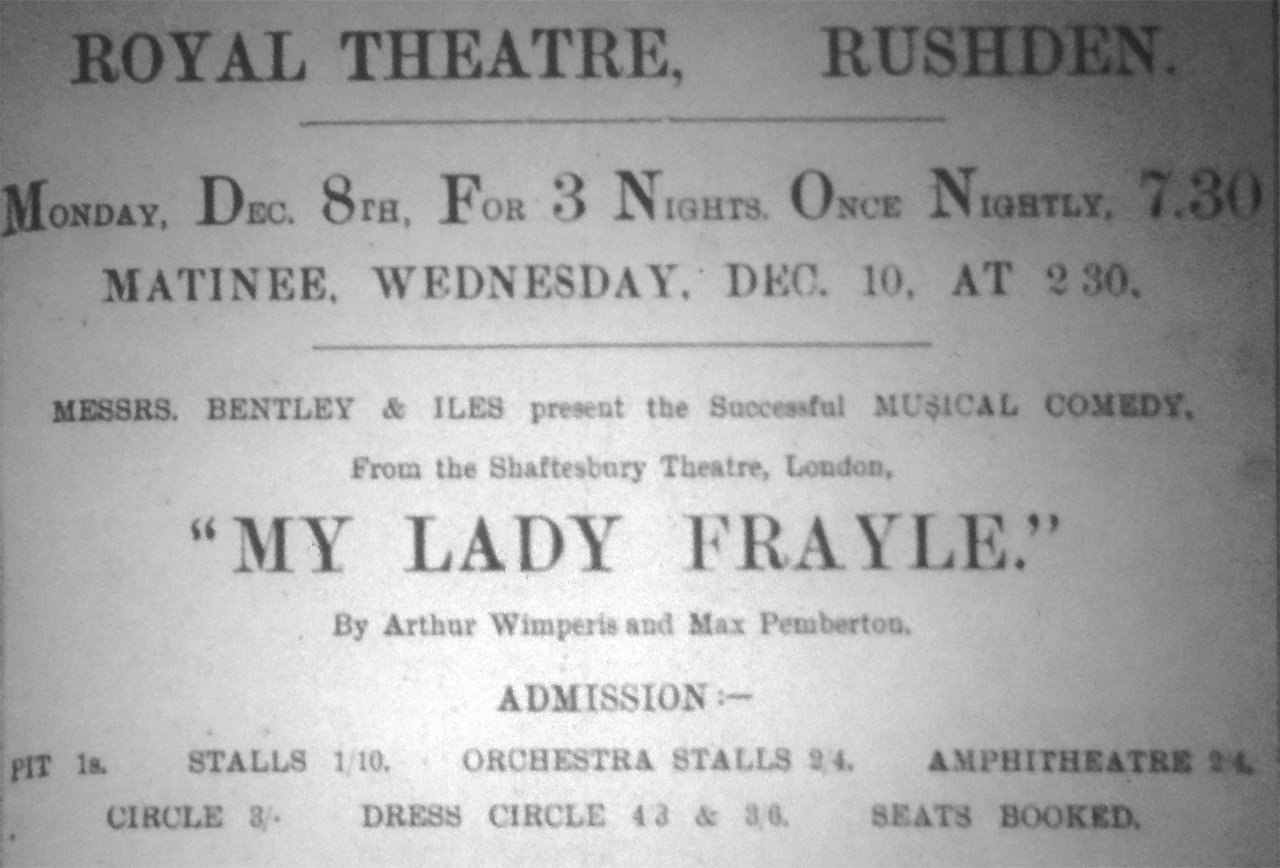
An advert from the Rushden Echo 5 December 1919
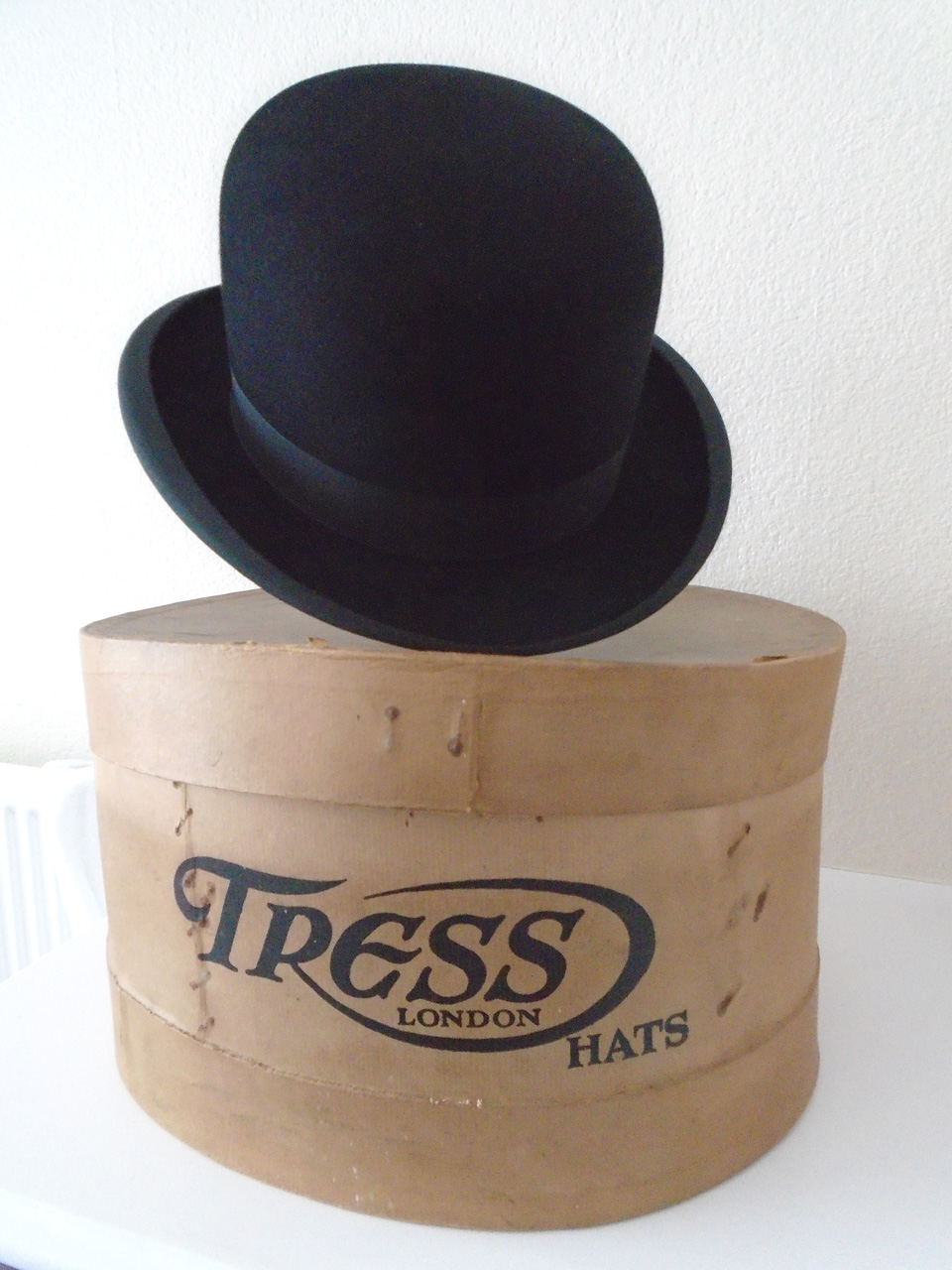
Bowler hat from Mr. Moody’s shop
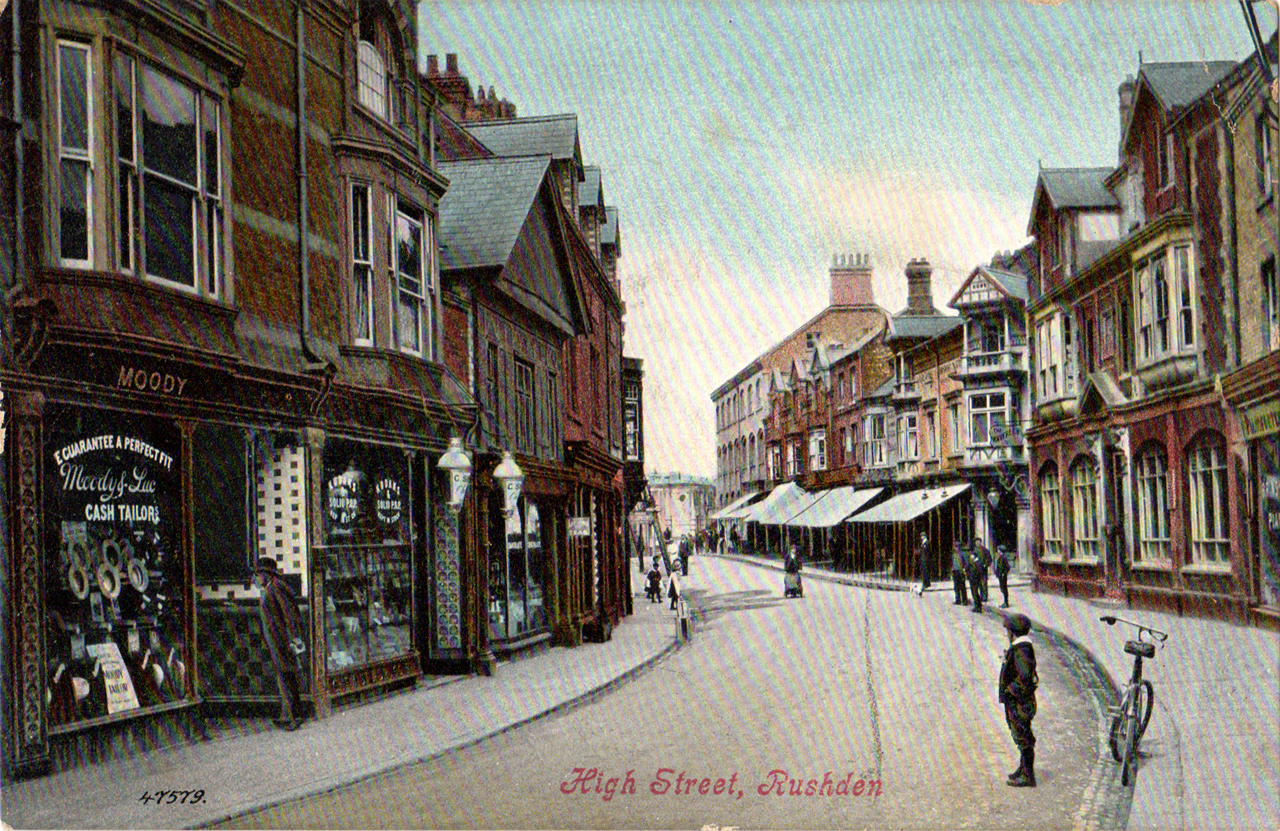
A postcard showing Mr. Moody’s shop on the left
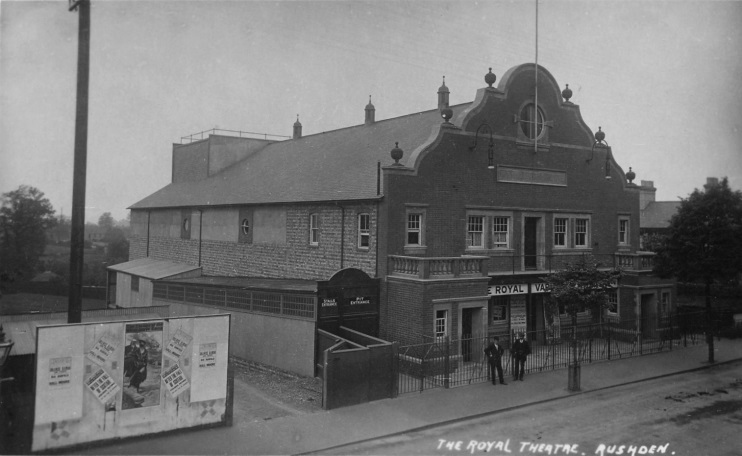
Almost every seat in the Royal Theatre in Rushden was booked for the 8, 9 and 10 December when the musical comedy “My Lady Frayle” was performed. According to the Rushden Echo the singing and dancing were met with tremendous applause, and the whole show was on a par with that at most London theatres. The orchestra was under the direction of Mr. A. Bartlett.
At the council meeting held on the 10 December in the Council Buildings, the problem of rats was discussed. It was reported that a lot of damage was done by rats, and that there was a regular rat run in Spencer Park. Spencer Park was Rushden’s first recreation ground and was opened in 1913. The land, approximately 8 acres, was bought by the Council from Messrs. Lilley, Skinner, and Sykes at £100 per acre. £500 was put aside to cover the cost of construction work, most of which was carried out by Mr. R. Marriott. It was then decided that the park would be more imposing if the council could buy the land, about 4½ acres, on the other side of the brook, which they eventually did.
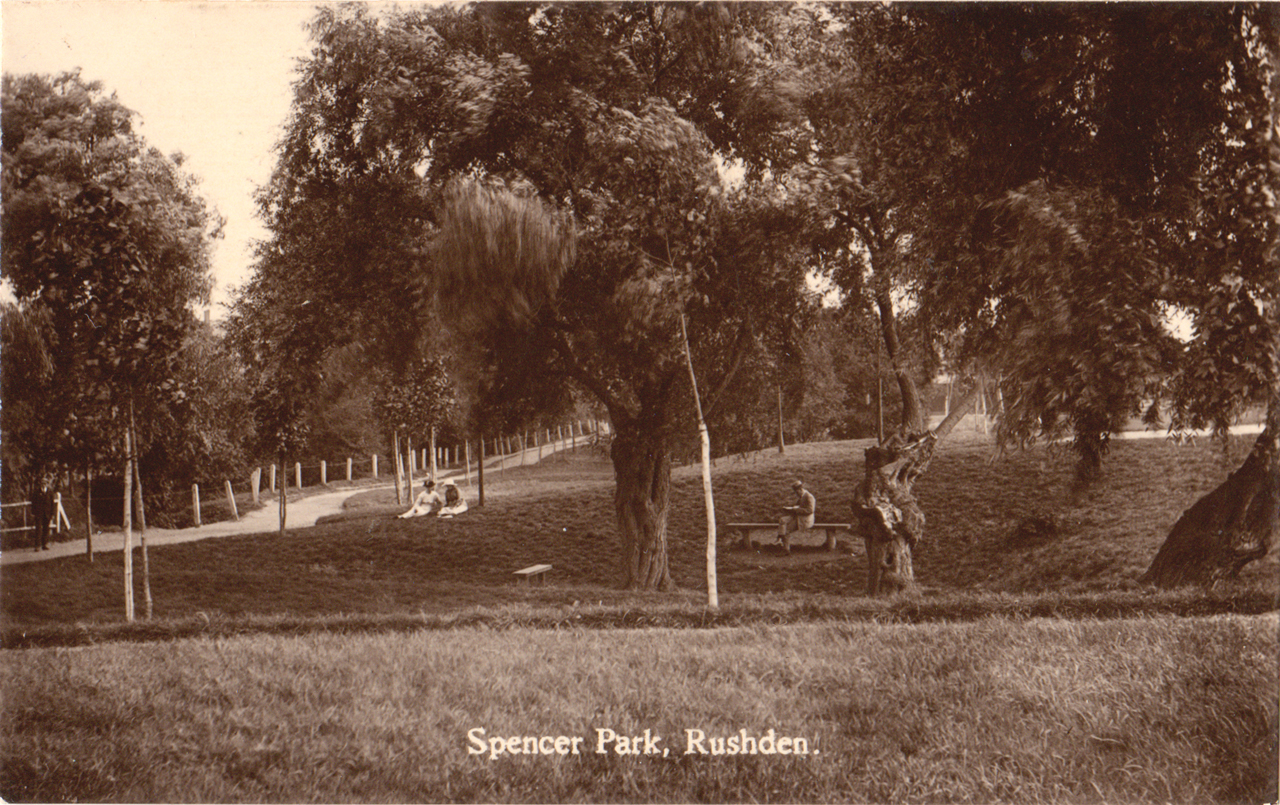
In January 1913, even before the park was open to the public, damage was being done by youths, and watchmen had to be employed. In spite of this, in May 1913 more damage was done to trees. By the time the park was opened in the autumn of 1913 the Council had already received applications from several organisations requesting the use of the football and cricket pitches.
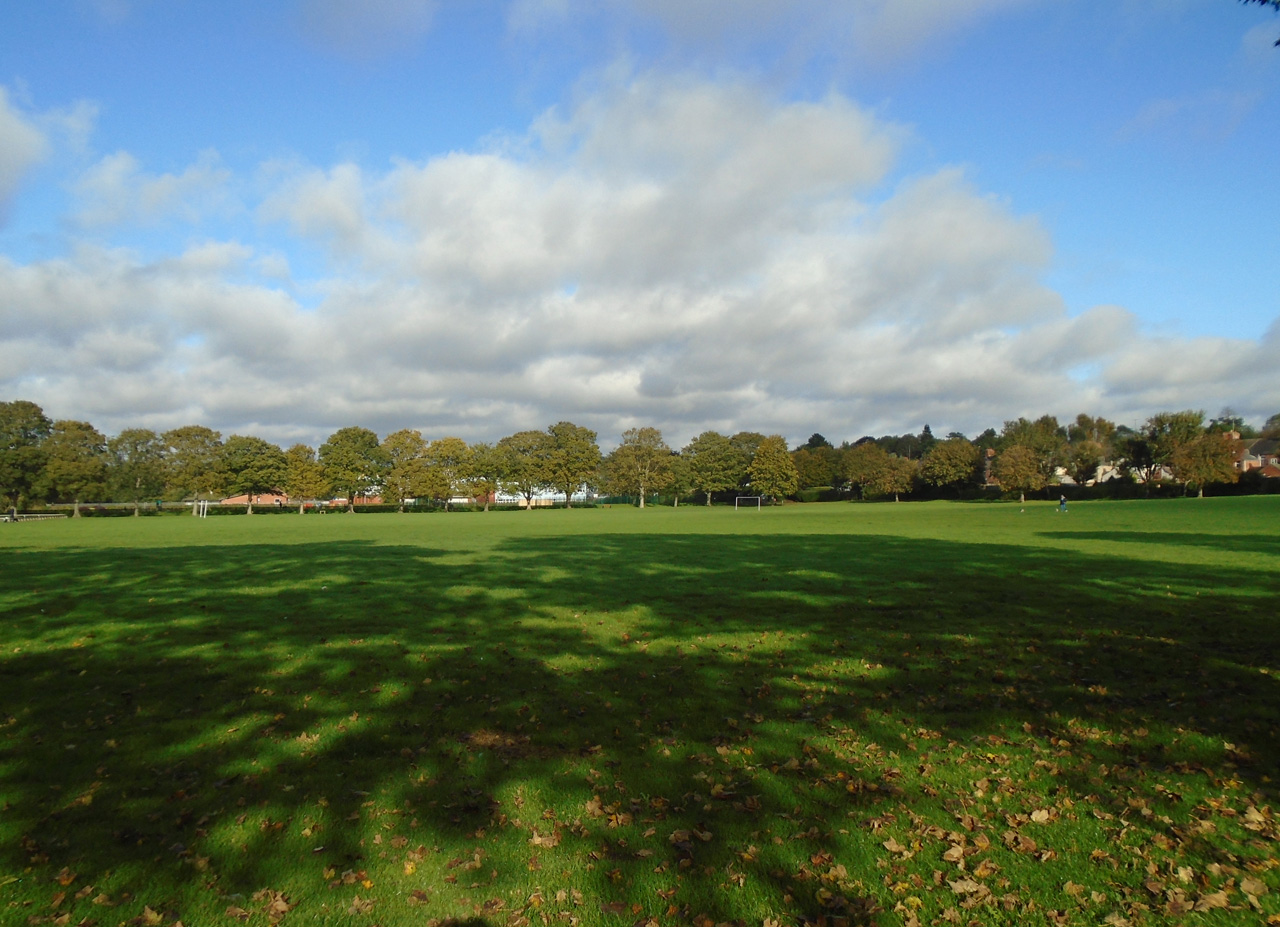
The football and cricket pitches in Spencer Park
Not much progress was being made in the building of the municipal houses, and it was suggested that if things didn’t improve the work should be undertaken by the Council using direct labour. Although there was great demand for more houses there was little building going on.
Two houses in Pemberton Street were sold by auction on the 8 December 1919. No. 11a contained:-
a front room, living room, large kitchen, scullery, 4 bedrooms, and the usual domestic offices. At the rear of this property there is a capable stable with loft over, built of brick and roofed with corrugated iron. Vacant possession of the house will be given on completion of the purchase. The stable and outbuildings are let at a weekly rental of 2s. per week. No. 13 is of brick and slate erection, and contains front room, living room, kitchen, 3 bedrooms, and the usual domestic offices, now in the occupation of Mr. Samuel Martin, and producing a gross rental of £14/6/0.
On 12 December, 1919 it was reported in the Rushden Echo that :-
SALE – Mr. John S. Mason on Monday sold by auction two dwelling houses, 11a and 13, Pemberton-street, one with a brick stable and loft at the rear, with vacant possession, and the other let at £14/16/0 a year. The property was sold at £640 to Mr. Jeffery Miller.

Pemberton Street, Rushden
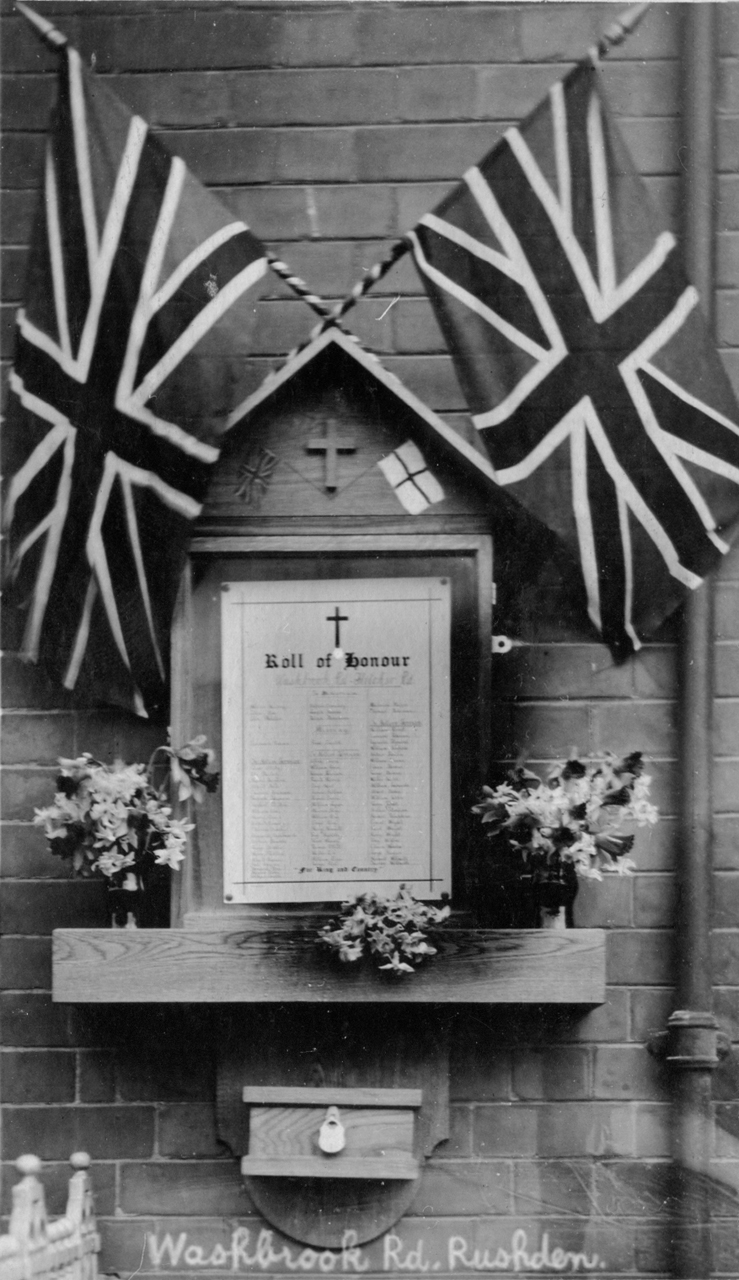
War Shrines were first seen in Rushden in 1917 and when peace was declared it was decided to leave the Shrines where they were for a year before deciding what should be done with them. The Shrines had been set up over the town, sometimes one per road, sometimes one for several smaller roads. The aim was to raise money to send to the men of those roads who were serving their country, in order that they might be able to buy cigarettes etc. They had been very successful, providing a place for families to put flowers in memory of their loved ones, and had also served to bring communities together. On 5 October 1917 the Rushden Echo reported that Mrs. Knight, secretary of the Cromwell Road Roll of Honour, had been able to send postal orders for 3 shillings to the 113 boys whose name was on the Roll. The money had been raised at a bazaar. The Shrines were not unique to Rushden but there were not many other towns that had them. On 23 November 1917 Mrs. Newman, secretary of the Washbrook Road and Fletcher Road Roll, received a ‘thank you’ letter from Frank Smith as follows:- “ I am with fellows from other parts of the country, but I never hear they have any such gifts. I am sure the boys from Rushden should be proud of the efforts everyone at home is making for them.”
Although no total had been kept it was thought that the shrines had raised thousands of pounds for the soldiers serving in the war. The general opinion of the various committees was that the shrines should be preserved and it was suggested that they ask permission for them to be placed in a room in Rushden library.

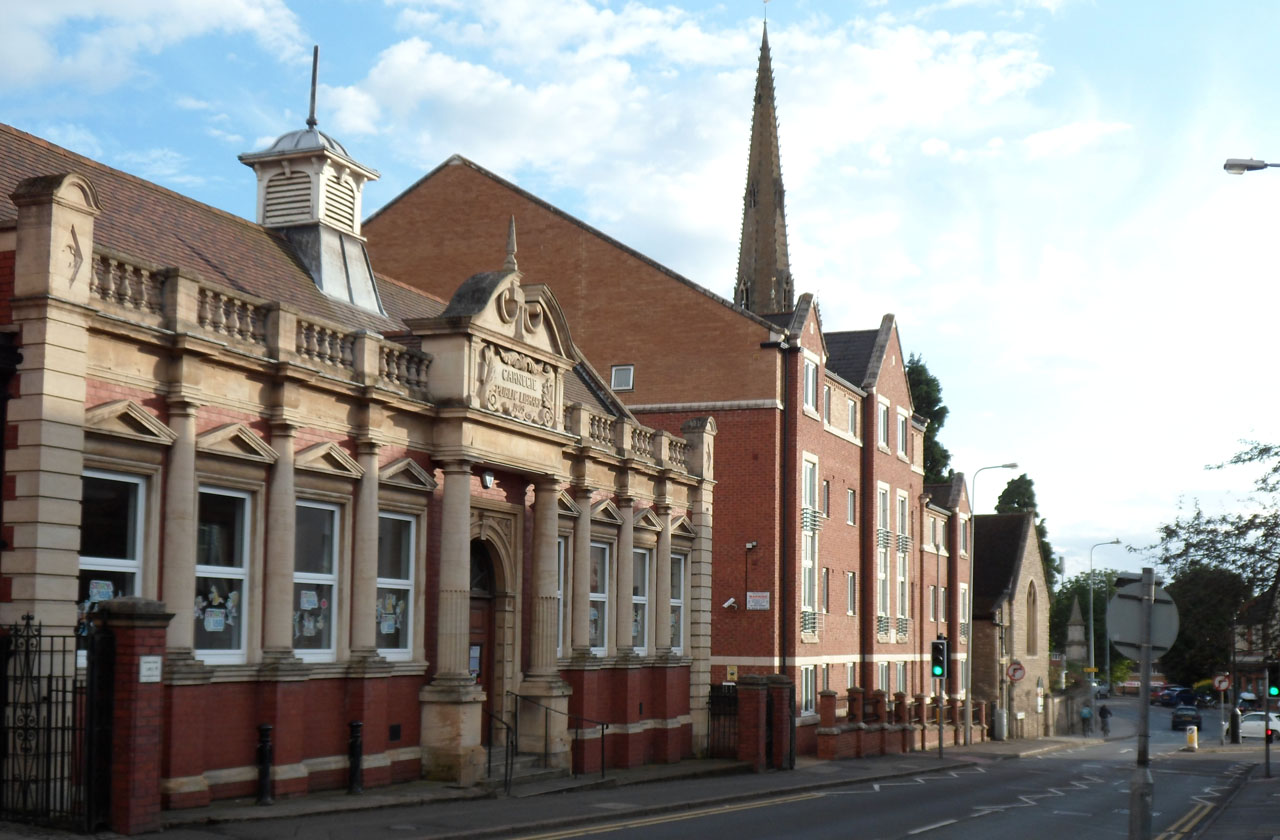
Rushden Library
Rushden Weather for 1919 from the Rushden Echo:
1919 was a very wet year with 26.14 inches of rain in 173 days. The wettest months were January, March, July and December. The driest months were May and June. The heaviest rainfall in 24 hours was on March 19th with .92 inches. The longest period without rain was from May 12th to 24th inclusive, 13 days. Snow fell on 11 days at the beginning of the year, and on 9 days in November, none being registered in December. Frosts were recorded on 68 nights in the early part of the year, the last on April 30th. The first frost of the winter was noted on September 20th and on 37 more occasions. The most severe frost recorded was 26.6 degrees on February 9th.