

It is not easy to appreciate nowadays just how difficult travel was in the 18th and early 19th centuries. There was no public transport available until 1785 when William Pitt, the then Chancellor of the Exchequer, authorised a mail coach route from London to Leeds which stopped with mail at the post office in Higham Ferrers. These mail coaches are not to be confused with stage coaches, as they were principally for carrying the mail but could accommodate 4 passengers inside, and later coaches also carried three outside passengers.
The mail coaches all left London at 8 p.m. and the Leeds coach arrived in Higham Ferrers at 5.55 a.m. the next morning. By 1837 the roads had improved to such an extent that the coach arrived earlier, 2.56 a.m. in Higham Ferrers. Contrary to present day perception of these coaches flying along at great speed the early coach had an average speed of 6.55 m.p.h. and this rose to 9.37 m.p.h. when the coach arrived at the earlier time.
Travel by coach was very uncomfortable, especially in the winter, when it was not unknown for passengers to freeze to death! It was also expensive as you not only had to pay the coach fare but a great deal of tipping was involved at the inn stops.
Stage coaches appeared later than the mail coaches and they carried more passengers and their luggage. By 1836 Rushden was on two major stage coach routes, one was the coach from London to Uppingham which left London on Tuesdays, Thursdays and Saturdays at 8 a.m. and returned on Mondays, Wednesdays and Fridays. It had 4 inside seats and 11 outside and took eleven hours to travel the 89 miles from London to Uppingham. The other coach was “Peveril of the Peak” which ran from London to Manchester, a distance of 189 miles which took 21 hours. This left London at 7.45 p.m. and the return coach left Manchester at 12 noon.
These coaches would have stopped in Rushden, to change horses, at the Waggon and Horses or the Coach and Horses Inn, both in High Street South, Rushden. The Coach and Horses Inn was part of the Rushden Hall Estate and after 1881 when the licensee, Thomas Hulatt, applied for the licence to be transferred to the Oakley Inn in Wellingborough Road, Rushden, it provided accommodation for members of the Hall staff

|
A postcard of High Street South with the Waggon and Horses in the centre of the picture. This is not the original building – it was rebuilt in 1892. It was converted into a restaurant in 2006. |
Wellingborough & Kettering News, August 6, 1881.
To the Overseers of the Poor of the Parish of Rushden, in the County of Northampton, and the Superintendent of Police for the Division of Wellingborough, in the said County of Northampton, and to all whom it may concern.
I THOMAS HULATT, now residing at the Coach and Horses Inn, Rushden in the Parish of Rushden in the County of Northampton, Licensed Victualler, do hereby give notice that it is my intention to apply at the General Annual Licensing Meeting to be holden at the Police Station in Wellingborough in the Division of Wellingborough in the said County on the 29th day of August next ensuing for an Order sanctioning the removal of the Licence for the sale by retail of Intoxicating Liquor, to be consumed either on or off the premises, now held by me, from the “Coach and Horses” Inn aforesaid to a new House situate on the North East side of the Road leading from Rushden to Wellingborough, and at the junction of such Road with the Road leading from Knuston to Higham Ferrers, the said new House being also in the Parish of Rushden in the County of Northampton and within the said division.
Given under my hand this twenty-ninth day of July, one thousand eight hundred and eighty one.
THOMAS HULATT
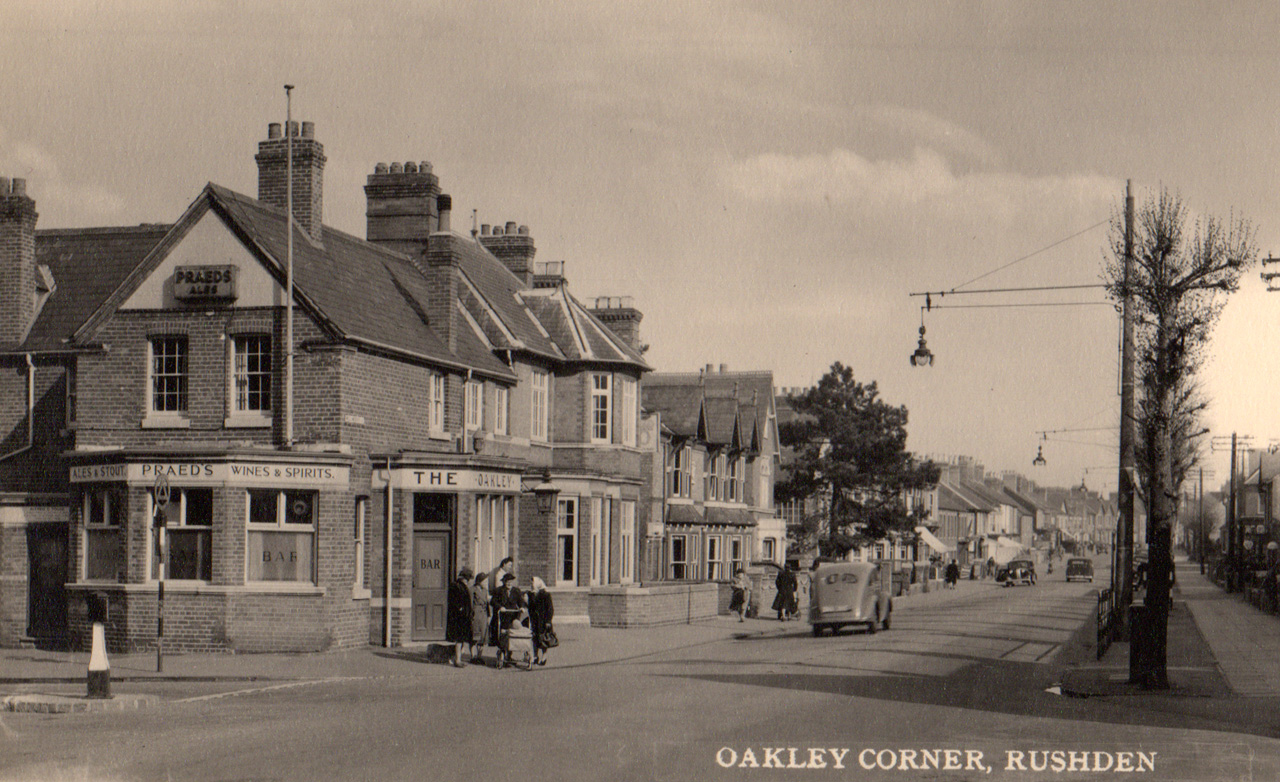
The Oakley Arms closed in 2008 and became a Pet Store. It has now been converted into apartments.

A postcard of the old Coach and Horses. On the left of the building is the Porter’s Lodge at the entrance to the Rushden Hall Estate.
In 1913 Mr. Josiah Brown applied for the old Coach and Horses Inn to be registered as a lodging house. It was inspected by the Medical Officer and found to be suitable for the purpose. It was inspected again the following year and found ‘satisfactory for the class of persons catered for.’ The rooms had been measured for sleeping accommodation and printed cards posted in each bedroom stating the number of persons allowed to occupy each room. It sounds delightful.
One can imagine what a revolution it must have been when the railway line from Peterborough to Northampton opened in 1845 with a station at Chown’s Mill and connections at Gayton, which was on the London to Birmingham railway, to get to London.