
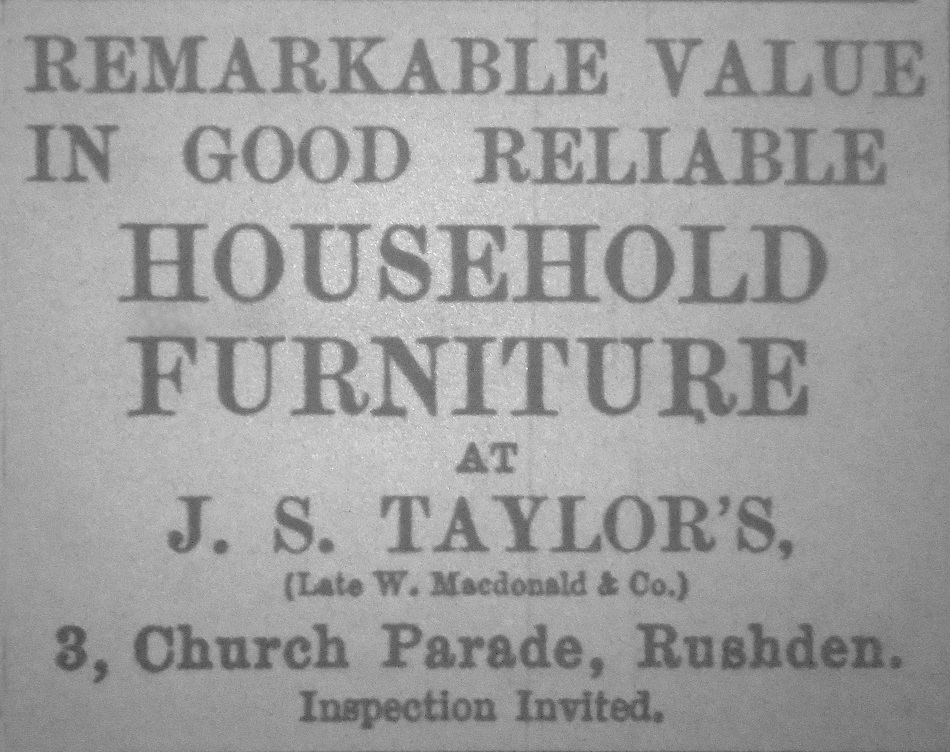
An advert from the Rushden Echo dated 6 July 1923
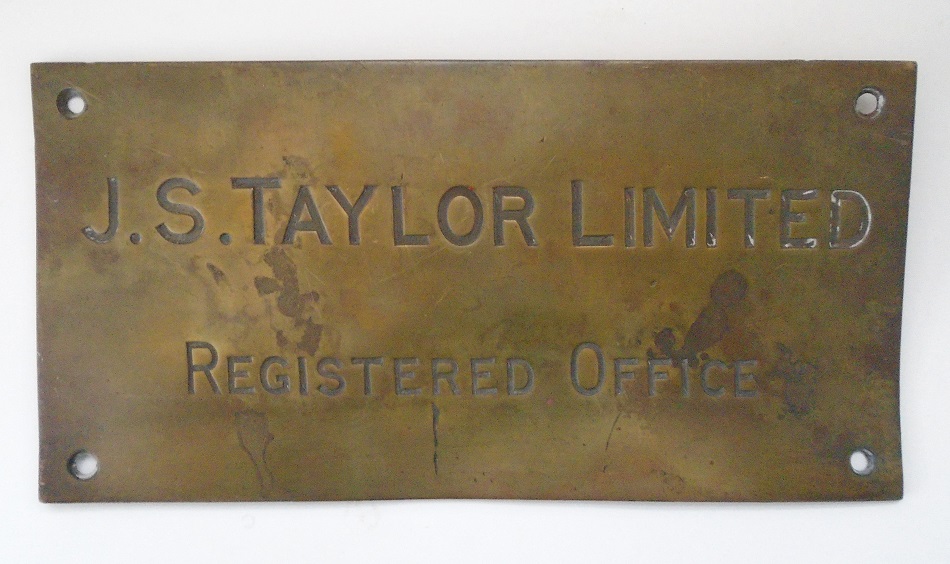
The brass plate from Taylor’s shop
On the 6 July 1923 the Rushden Echo reported that a party of 36 trippers had visited Leamington in a charabanc supplied by Mr. G. Robinson. The left Rushden at 8 a.m. and reached the beautiful town of Leamington about 12.30. The day trippers had luncheon and then visited the historic Warwick Castle and other places. After an enjoyable run home, Rushden was reached about 11 p.m.
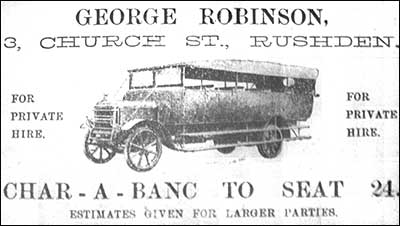
An advert for George Robinson’s charabanc
At the Council meeting on 11 July 1923, held in the Council Buildings, it was resolved to provide six additional seats near the tennis courts and the bowling greens in Spencer Park at an estimated cost of £15.
Thanks were passed to the anonymous donor of the paddling pool, which was highly appreciated and to Mr. Madin, the surveyor, for the excellent manner in which the pool had been laid out. It was said that the park was used by such a large number of people that the time had come when the council should consider extending the park.
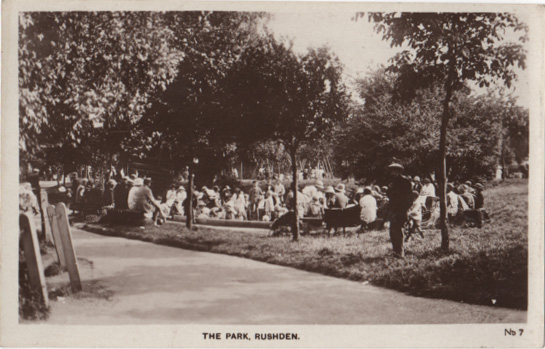
The paddling pool in Spencer Park
On the 16 July 1923 Mr. John S. Mason conducted a sale of property at the Waverley Hotel which included Gladstone House, in Griffith Street, Rushden. This was the former home of the late Mr. Percy Collins who was a heel maker for the boot and shoe industry. Sadly, Percy Collins died following an accident in Rushden on the 21 November 1911, when he was just 36 years old. He was riding in his trap, accompanied by his groom/handyman Walter Moore Stringer. They had negotiated “Ward’s Corner,” and standing outside the shops of Mr. Charles Robinson, newsagent, and Messrs. Meadows and Rattley, fish merchants, was a four-wheel trolley belonging to Mr. Jesse Quick, green-grocer. A wheel of Mr. Collin’s trap caught Mr. Quick’s trolley, and the trap was turned over, throwing Mr. Collins out. Mr. Stringer was unhurt, but Mr. Collins hit his head on the kerbstone fracturing his skull. It was obvious that Mr. Collins’ injuries were serious, and he was taken into Mr. Robinson’s shop and placed on a couch in the sitting room. Nurse Tenney was soon on the scene and Dr. Greenfield arrived after about 10 minutes. Mr. Collins was carried to his home on a stretcher and at about 3 o’clock in the afternoon he died. He left a widow and six young children.

The end of the High Street where the accident happened
Gladstone House was described as having an entrance hall, drawing room, dining room, breakfast room, five bedrooms, boxroom, bathroom, etc., also office, stone outbuildings, a large lawn, gardens, and greenhouse. It was sold to Mr. B. Coe for the sum of £1,525.
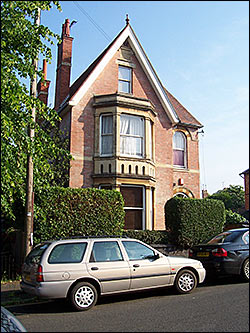
Gladstone House
At the end of July 1923, a letter of protest was sent to the Clerk of the Northants County Council and to the chairman of the Roads Committee, calling their attention to “the very bad condition of the main roads in the county.” The letter was signed by Mr. Christopher Smyth, Lord Annaly, Sir Charles Gurning, Lord Vaux of Harrowden, Lord Erskine, Col. Sotheby, Major Wetherall, Major-General Stockdale, Major Leslie Renton, Mr. A. H. Thurburn, Mr. A. H. Sartoris, and Capt. Geoffrey Elwes.
The problem was one of finance. Northamptonshire rates were very low and might need to be raised to provide more money to bring the roads nearer to the standard set in adjoining counties.
Nothing changes!