


An advert from the Rushden Echo
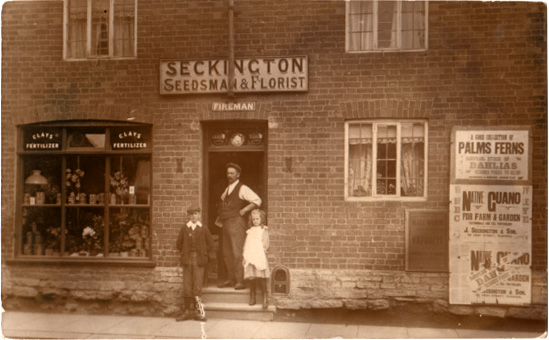
Seckington’s shop in the High Street
The death was recorded of Mr. George Smith, aged 85, who was the first resident of Rushden to receive the old age pension. He had lived in Rushden for about 32 years, and at the time of his death was living with his daughter and son-in-law, Mr. and Mrs. T. H. Elliott, of 19 Midland Road, Rushden.
When the Old Age Pension Committee met at the beginning of April, of the 13 claims made, nine were granted 10s, two 8s., and two 2s. a week. One pensioner was disqualified.
As with this year, 1921 was census year. Mr. G. R. Turner, the Registrar, was appointed to the superintendency of the census taking for Rushden, Higham Ferrers, Irthlingborough, Newton Bromswold, Wymington, Podington, Hinwick, Bozeat, Easton Maudit, Grendon, Wollaston, and Irchester. It was the fourth time Mr. Turner had had the superintendency of the district.
Mr. Turner was also a member of the Rushden Volunteer Fire Brigade which was formed in 1877 until he retired in 1919. He attended a good many of the fires in Rushden including Mr. Buckle’s shop in High Street in 1900, Ellard and Howes factory, York Road, in 1906, and George Miller’s shop, High Street in 1917.
.
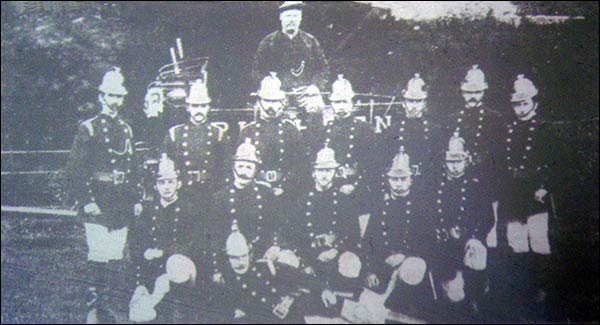
The Volunteer Fire Brigade in 1889. Mr. Turner is lying down at the front
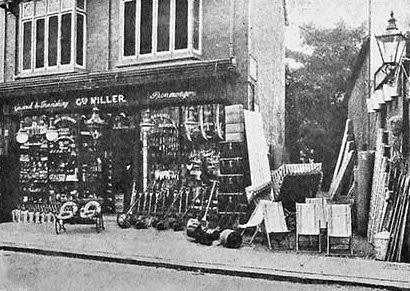
George Miller’s shop in High Street

The remains of Mr. Buckle’s shop after the fire

Ellard and Howes factory in York Road
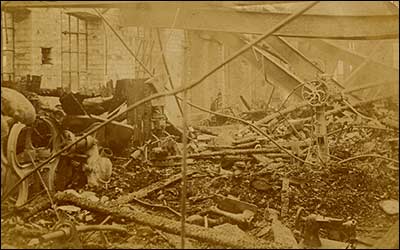
Inside the factory after the fire
The Rushen Urban District Council received a letter from the Divisional Food Commissioner stating that it was proposed to revive Food Control Committees. Officers who had served in that capacity before were likely to be required to act again. Volunteers might be necessary. In the case of a railway strike, it was hoped that particulars of abandoned perishable goods en route should be passed on to the consignees and arrangements be made to transport the goods. The Rushden Food Control Committee was to be asked to meet again and deal with the matter before them, and that Mr. C. W. Wing and his staff be re-appointed to undertake the clerical duties.

An Emergency Food Officer badge. This one is from WWII and was made by H. W. Miller Ltd.,
116-118 Branston Street, Birmingham
Your content goes here. Edit or remove this The Council were also asked to set up again the machinery for rationing fuel supplies and to find out what stocks were held, especially by the big institutions. Domestic coal was not to be used for any industries but the most vital. The local authorities were not empowered to commandeer stocks. The Coal Merchants’ Federation were to take on the distribution of fuel, and the Council were asked to nominate members to meet with the coal merchants. It was suggested that the Rushden coal merchants be asked to meet and form a committee, and that the Council act with that committee. Fortunately there was not a great deal of industrial coal used in Rushden.
Mr. Wilmott, Mr. Spencer and Mr. Bazeley were asked to serve on the committee and Mr. Madin was requested to act as fuel overseer.
Householders were limited to 1-cwt of coal a week, and could not have any further deliveries if they had a stock more than 2-cwt. Public lighting was to be reduced to the minimum.

Coal Stocks held by merchants in Rushden were reduced from 29 tons to 30-cwt in a week, held by one of the biggest merchants, with possibly a few cwts that the other merchants had in stock. The local fuel control committee were not authorised to commandeer stocks, but in view of the useless material which had been sent out last time as “emergency coal,” they did not feel justified in applying for another consignment, and asking the people to pay for something that would not burn.
When the Fire Station was built in 1901/2 it was built next to the Council Depot in Newton Road and the house attached to it was to be occupied by the Council Road Foreman, who at that time, also happened to be a fireman. By 1921 it was occupied by Fireman J. Whiting, but owing to the amount of valuable stock kept at the Council Depot, it was decided that the Road Foreman should be living there and that Mr. Whiting, who had lived there for 14 years, should be given a month’s notice. The Captain and Hon. Secretary of the Brigade attended the meeting and pointed out the desirability of a fireman residing in the cottage. Mr. Bazeley also pointed out that Fireman Whiting was not paid to be on the premises all day and night and that in his absence his wife called the firemen when required.
After more discussion it was decided to refer the matter back to the committee.
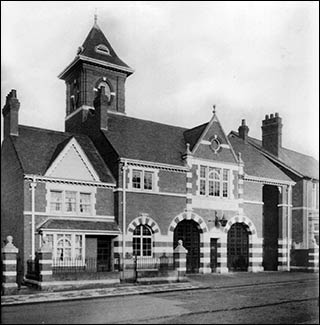
The Fire Station showing the cottage on the left hand side