

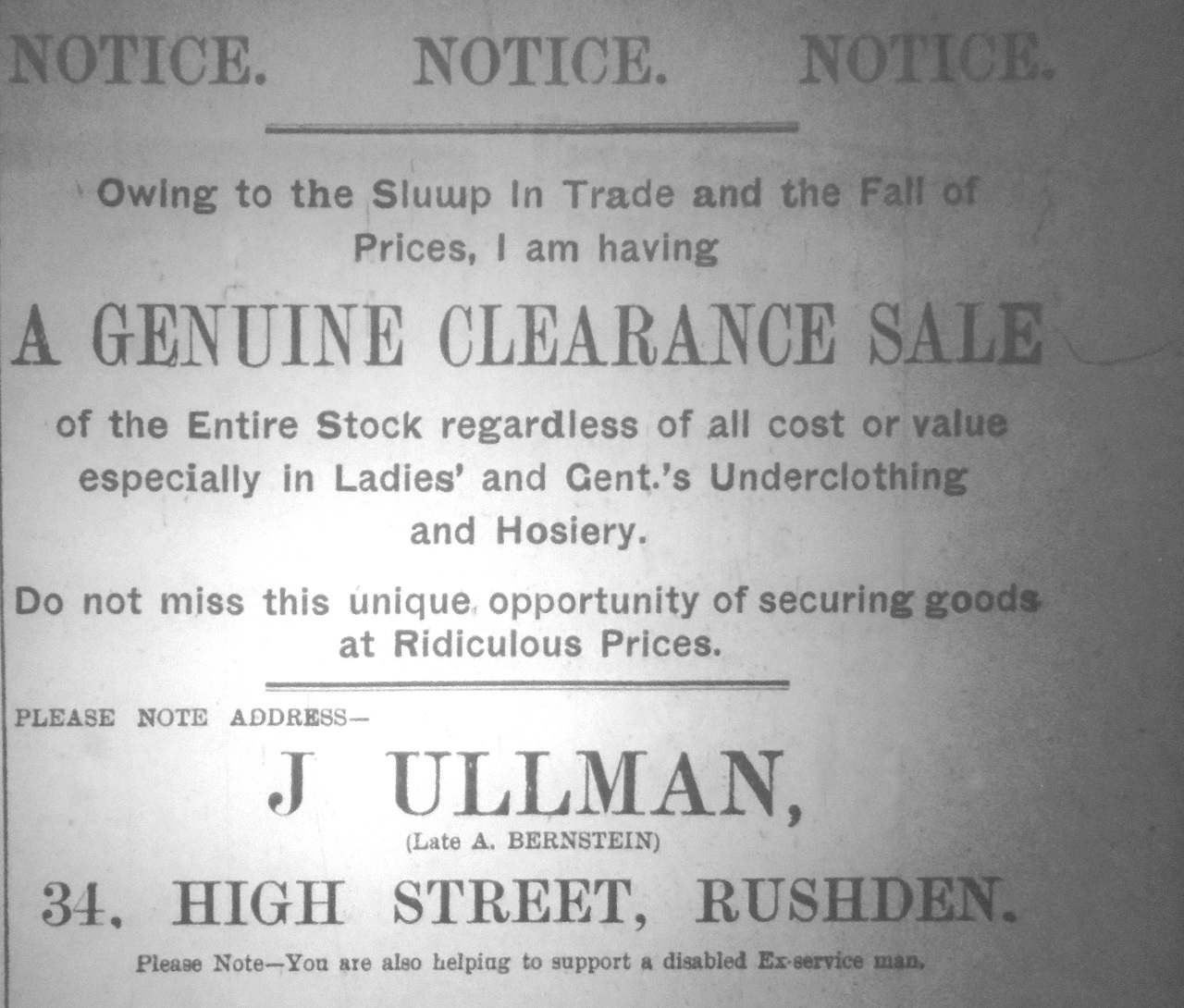
An advert from the Rushden Echo
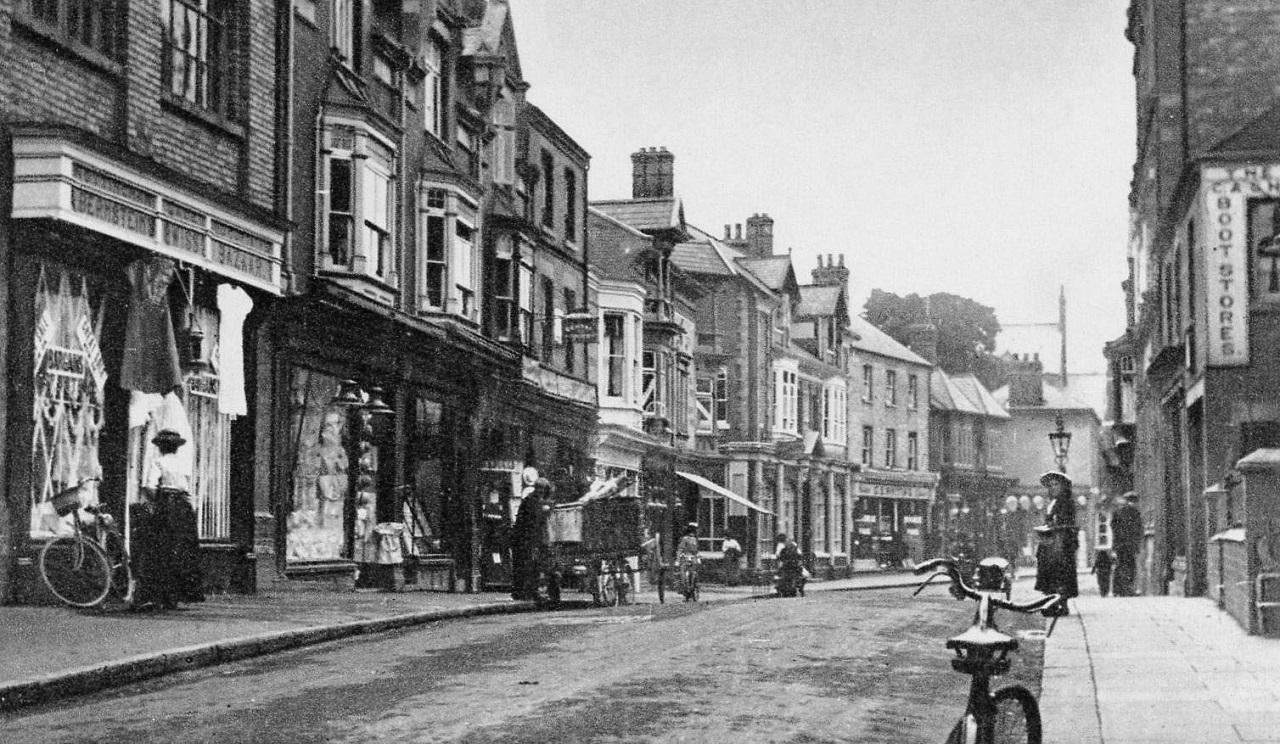
Ullman’s shop is on the left of the picture.
January 1921 saw a heavy fall in prices in the High Street and many people were out buying bargains at the various shops. Some people were hanging on hoping the prices would fall even further but one of the Rushden outfitters thought the prices would soon rise again and remain steady at the higher rate. He did not think the drastic reductions would be permanent. As you can see from the advert above, Mr. Ullman was taking advantage of the situation and having a stock clearance sale.
The County Council approved of the capital expenditure of £43/16/6 on extension to the heating apparatus at the Alfred-street Council Schools, Rushden.
The quarterly return of the Attendance Officer showed the following percentage of attendances:- Newton Road Mixed – 353.7 – 89.2%; Alfred Street Mixed – 304.3 – 90.2%; North End Mixed – 287.9 – 92.3%; Church of England Mixed – 203.8 – 89.0%; Newton Road Infants – 231.1 – 87.0%; Alfred Street Infants – 134.1 – 86.5%; North End Infants – 98.9 – 89.6%; Moor Road Infants – 127.2 – 88.9%; Church of England Infants – 114.1 – 85.9%.

A class in Newton Road School 1922
The County Education Committee gave notice of the transfer of the Church of England day school to the Local Authority. The Rev. P. E. Robson (Rector) explained that the Managers of the Church of England School had approached the County Authority, as they were unable to face the prospect of an expenditure of £10,000 on new school premises.
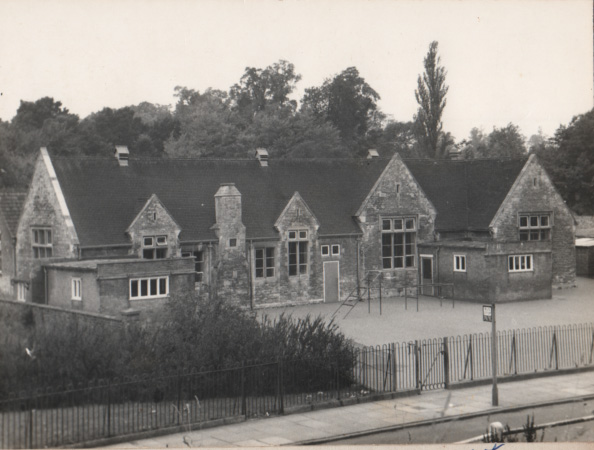
The Church of England School – later South End School
There was still a lot of unemployment in the town and the Rushden Distress Relief Fund held collections in the streets and at the Town Ground when matches were being played. The Temperance Band also played in aid of the fund. Since the Rushden Distress Relief Fund had been formed, £22 had been distributed in the form of credit tickets. The Committee believed that there was no-one in Rushden on the verge of starvation but there were some cases where the head of the household was not willing to accept monetary gifts and the families were existing on little more than bread and cheap fats. The number of unemployed in Rushden and Higham Ferrers who received out-of-work benefit from the Boot Operatives’ Union was 333, but by the next week that had been reduced to 200.
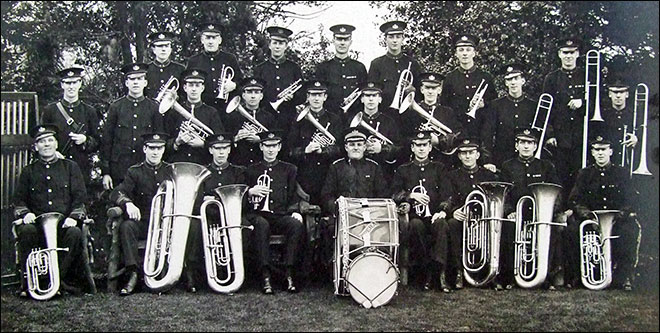
Temperance Band 1922
The Government had decided to provide a grant of three million pounds for the purpose of assisting Local Authorities to carry out works on which a substantial number of unemployed could be engaged. The grants would not exceed 30 per cent. of the wages bill of additional men taken on for the work and would not be made in respect of work on roads and housing.
The Council did not think the grant would be much use in Rushden as they couldn’t put the council men on short time and the boot trade was already on short time.
In the end it was decided that men could be employed in levelling Spencer Park, although they would need to work under skilled supervision. The football clubs were asked to give up their pitches for the remainder of the season, and work was to start as soon as possible, employing as many of the unemployed as they could at the rate of 1/3 per hour.
It was estimated that the cost would be about £300 and the council applied for a grant of £270.

The football pitches in Spencer Park
The affairs of Mr. F. Simpson, tailor, 53, High-street, Rushden were thoroughly investigated on the occasion of the recent fire, which occurred on December 3, 1920, and were found to be very satisfactory. The assets, including stock, fixtures, fittings, and utensils in trade, amounted to £1,474, and the liabilities to four creditors to £145/10/6. The trade returns for the eleven months were £3,525/17/6, excluding £67/10/0 orders in hand and not completed at the time of the fire. The outstanding debts were £8/4/9.

An advert for Mr. Simpson’s Salvage Sale
At the beginning of January a severe thunderstorm passed over Rushden, including a heavy fall of hail. However the 9 January was the mildest January day in 80 years, and it was five degrees warmer than July 5 of 1920. It was also only one degree cooler than the last day of August 1920. Global warming hadn’t been invented then so it must have been Mother Nature having a bit of fun.