
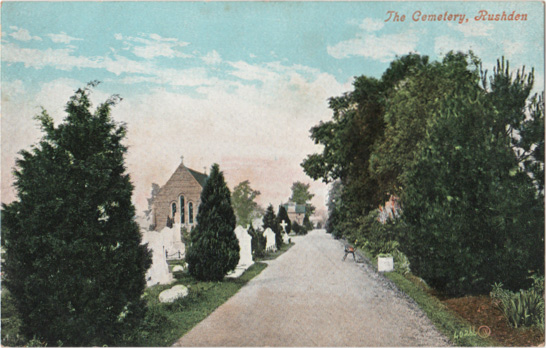
On the 4 November 1887 the Wellingborough News reported a Local Government Board Inquiry, held in the Vestry Hall in Rushden, regarding an application for sanction to borrow £1,700 to provide a cemetery at Rushden.
The Inspector from the Local Government Board asked for details of the population and rateable value of the town and was told that at the 1881 census the population was 3,658 but a large number of houses had been built since then and that the population was now more likely to be 5,500. The present rateable value was £12,516, and that the rates were 4s in the £. The acreage of the town was 3,609 acres. On being told that there was no public water or any sewage works in the town, the Inspector thought the rates were rather high.
Canon Barker pointed out that they could only go on burying in the churchyard until the next summer and that the burial ground belonging to the Old Baptist Meeting was almost full.
The whole of the land on offer, which belonged to Canon Barker, was nine acres at £100 per acre, which was considered reasonable. There was also to be a chapel and a caretaker’s house.
It was decided that the Inspector needed more information as to how the money was to be spent, and Mr. Cooper, the architect, was instructed to send plans, specifications and estimates. The Council were eventually able to go ahead with the work and the cemetery was dedicated in September 1888 by Canon Barker.
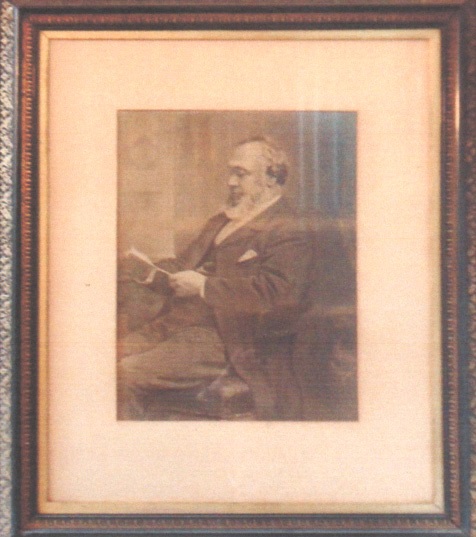
Canon Barker

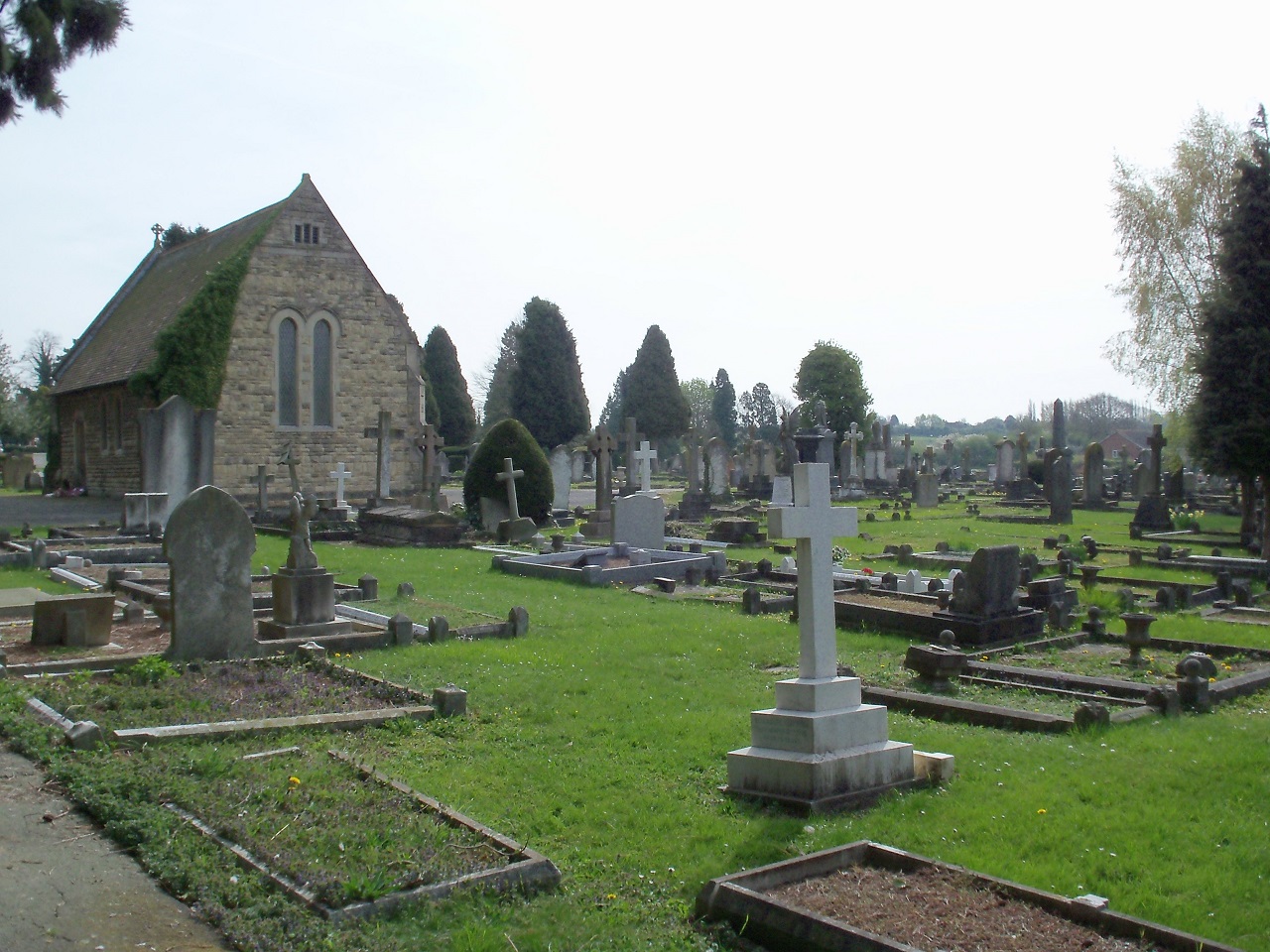
The Chapel in the Cemetery
One of the early burials in the cemetery, in January 1891, was that of Mr. Joseph Dickens, aged 71 years. Mr. Dickens was a farm labourer who lived in a cottage on the Bedford Road on the outskirts of the town, opposite Dial Farm. He was single and was described as an inoffensive, respectable citizen. On the 21 January, 1891, after returning home for his dinner at about 1.20 p.m. he left around 2 p.m. to return to his work. He didn’t return at the usual time in the evening and his employer, Mr. Wyldes, was informed. A search was carried out in the evening and some of his tools were found. The body of Joseph Dickens was discovered in a ditch the next day. He had been shot. No-one was ever charged with his murder. He was buried in Rushden Cemetery on the 26 January, 1891.
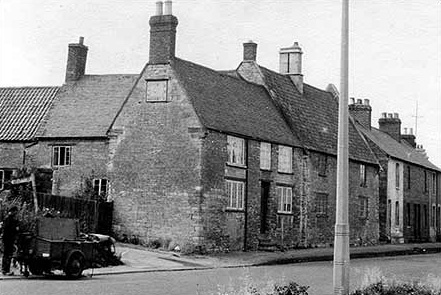
Dial Farm on the Bedford Road, Rushden
This picture is from the Colin Bryant collection, now in Rushden Museum
In June 1898, Mr. Bayes, the caretaker at the cemetery, reported to the Council that he had received complaints of flowers being stolen so he had kept watch. He caught a young girl, who said she was 12 years old but turned out to be 16, taking flowers from a shrub. She was summoned to attend the next meeting of the Council, which she did along with her mother. An apology was received and a caution given, but at the same meeting further damage was reported and the ‘delinquent’ was ordered to attend the next Council meeting. At the next meeting a Mrs. Partridge attended and her apology was also accepted but the ‘delinquent’ is not named.
In September 1899 4 boys, all from Crabb Street, were reported for damaging the May bushes, but the boys had all been suitably punished by their parents so no further action was taken.
The damage continued at various intervals and in 1907 the Council took proceedings against boys causing damage. In another instance three boys agreed to pay 1 shilling each to cover the cost of repairing the notice board which they had damaged.
The caretaker’s wages seemed to be regularly increased by 2 shillings per week, and by August 1914, Mr. Sabey, who was the caretaker at that time, had his wages increased from 28 shillings to 30 shillings per week.
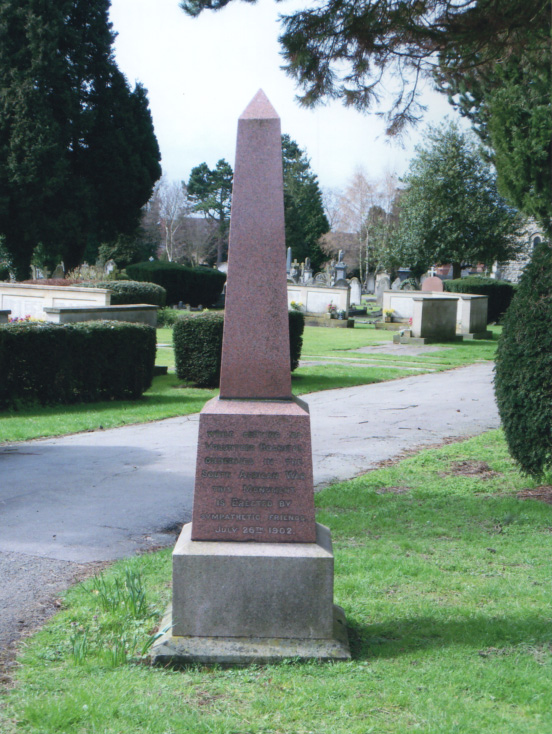
In May 1902 an application was received from a committee formed for the purpose of erecting a memorial to the memory of Charles R. Bettles and A. Ellis, who died when on active service as hospital orderlies in South Africa, asking the consent of the Council to the erection of such a memorial on a suitable site in the cemetery. The Cemetery Committee recommended the Council to accede to the application, and the Chairman, with Mr. Claridge, were appointed to meet the committee for the purpose of selecting the site.
The monument was unveiled in July 1902 by Mrs. P. Cave in the absence of her husband, who was president of the local corps of the St. John Ambulance, but who was in South Africa. The monument is a red Aberdeen granite obelisk, 9ft. high, and stands just inside the Newton Road entrance to the cemetery. The scheme had been organised and carried out by the local corps of the St. John Ambulance, assisted by the Young Men’s Classes at Park Road Baptist Chapel and the Wesleyan Methodist, with which the two young men, Bettles and Ellis, were formerly connected. The inscription of the monument is as follows:
“To the memory of Charles R. Bettles, who died at Bloemfontein, June 29, 1900, aged 19 years; and Arthur Ellis, who died at Johannesburg, August 2nd, 1900, aged 19 years, while serving as Volunteer Hospital Orderlies in the South African War. This monument is erected by sympathetic friends. 26th July, 1902.” Also on the left-hand side of the monument is the text: “Greater love hath no man than this that a man lay down his life for his friends.”
In June 1909 the attention of the Council was drawn to the increasing number of glass shades or globes and other ornamental memorials being placed on the graves. It was becoming unsightly and was making the caretaker’s work more difficult. Neighbouring authorities were contacted to discover what their regulations were, and replies were received from Kettering, Wellingborough and Bedford. It was decided to adopt similar regulations as Bedford so that not more than one glass shade or similar ornamental memorial be allowed on a grave, and that it be submitted to the Council for approval. It could not be more than 16 inches wide. For those graves that already had more than one memorial it was suggested that the Council require them to be removed by the 30 September. It appeared that Kettering Council charged for memorials to be put on the graves, but the Rushden Council did not want to discriminate between the rich and the poor. By October there were still some glass shades and artificial wreaths on graves and it was decided that any remaining after 31 October were to be removed by the caretaker.
In July 1922 it was decided to charge 5 shillings in respect of marble vases placed on the graves.
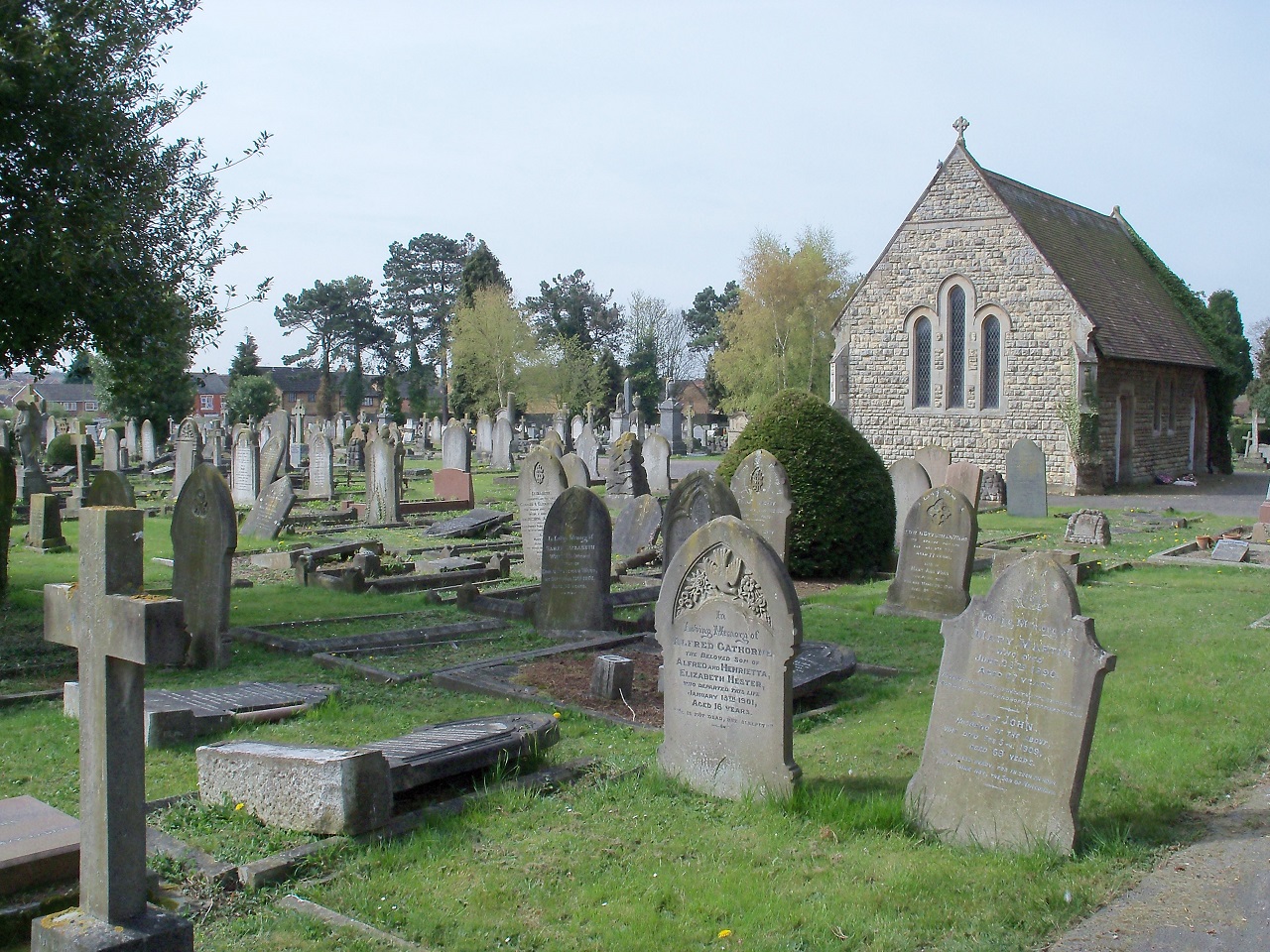
Many of the prominent citizens of the town are buried in the cemetery, including the footwear manufacturers. Below are some of their graves..
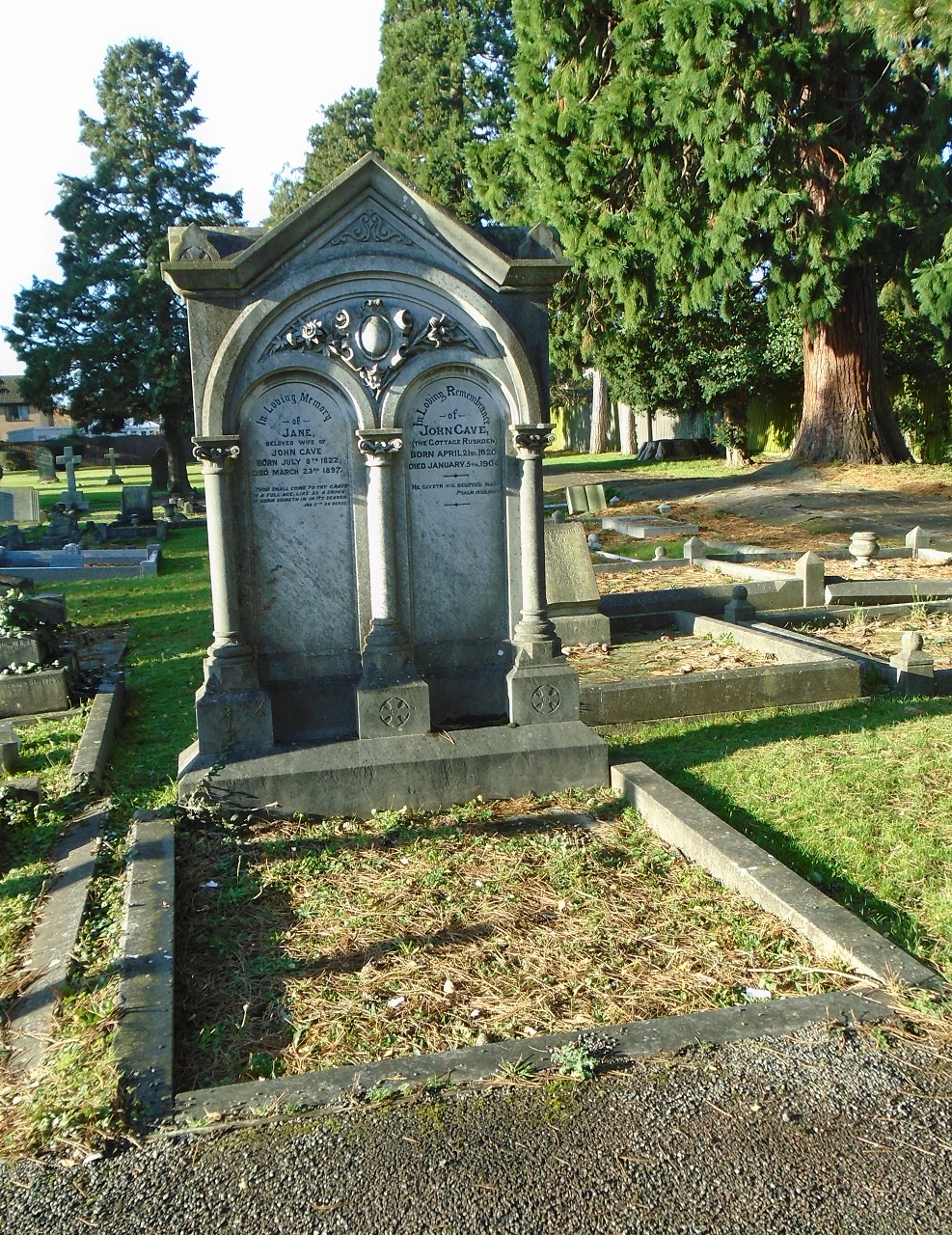
Mr. John Cave – January 1904

Mr. William Cumberland Knight – February 1915
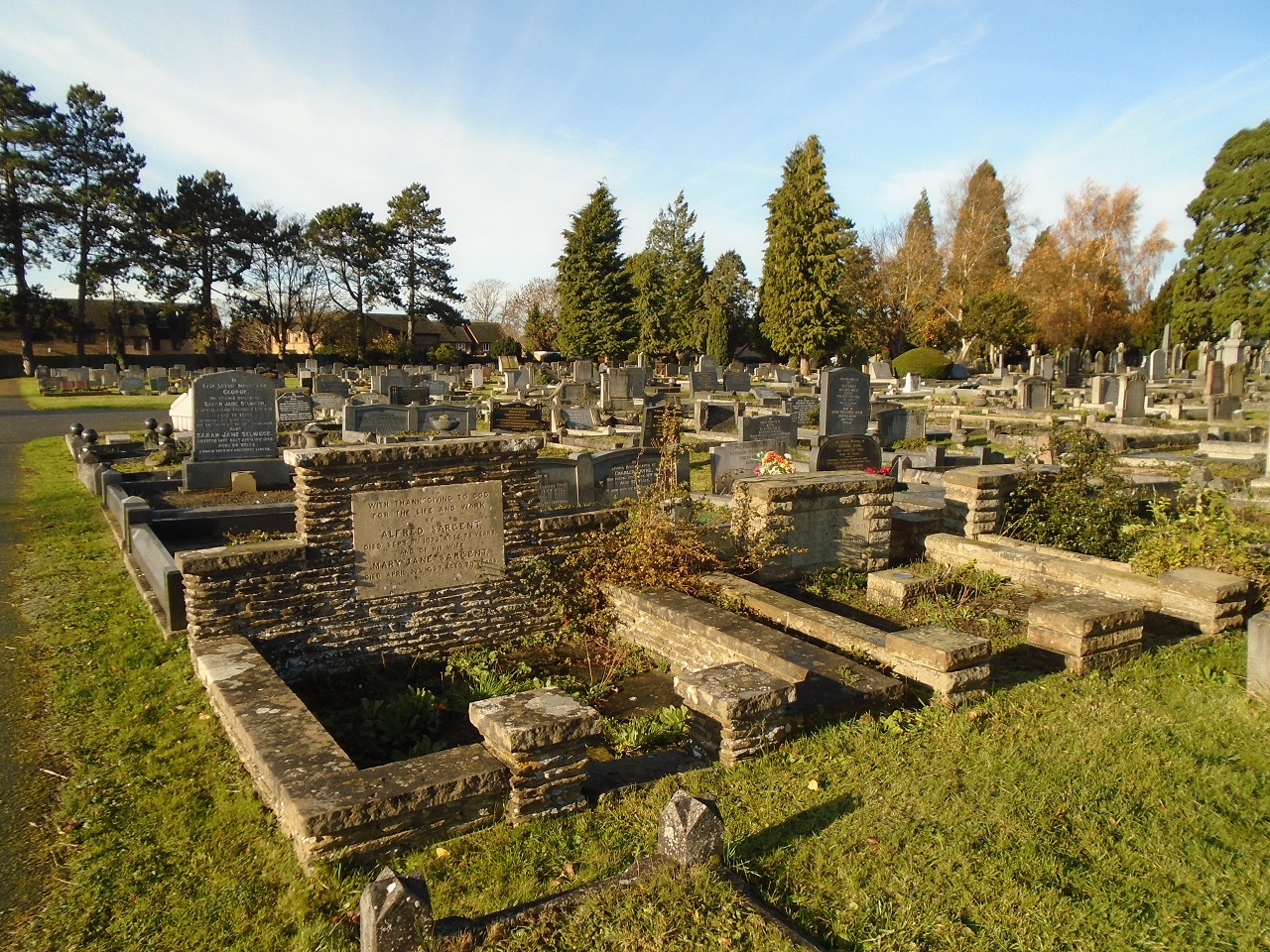
To the left of the picture: bottom – Alfred Sargent, September 1932; and beyond that George Selwood, 1931.
In April 1933 the Cemetery sub-committee of the Council were considering terms and conditions for a new Caretaker. They decided that he should be forbidden to receive any fees or gratuities, and that all such fees should be paid to the Cemetery Registrar at the Council Buildings. It was also decided that a charge of 2s. 6d. be made for the protection of wreaths, etc. from frost, and that the present charge of 3s. 6d. per annum for the planting of graves be exclusive of flowers.
At the same meeting Councillor Tysoe said he did not want to be known in Rushden as the “Watering Can King,” but as he had pointed out before he had experienced difficulty in finding a can. Many people failed to return the cans to the rack, which he thought was gross selfishness. A bit like a supermarket trolley!
The cemetery is now in the care of Rushden Town Council and is well maintained – no watering cans though.