

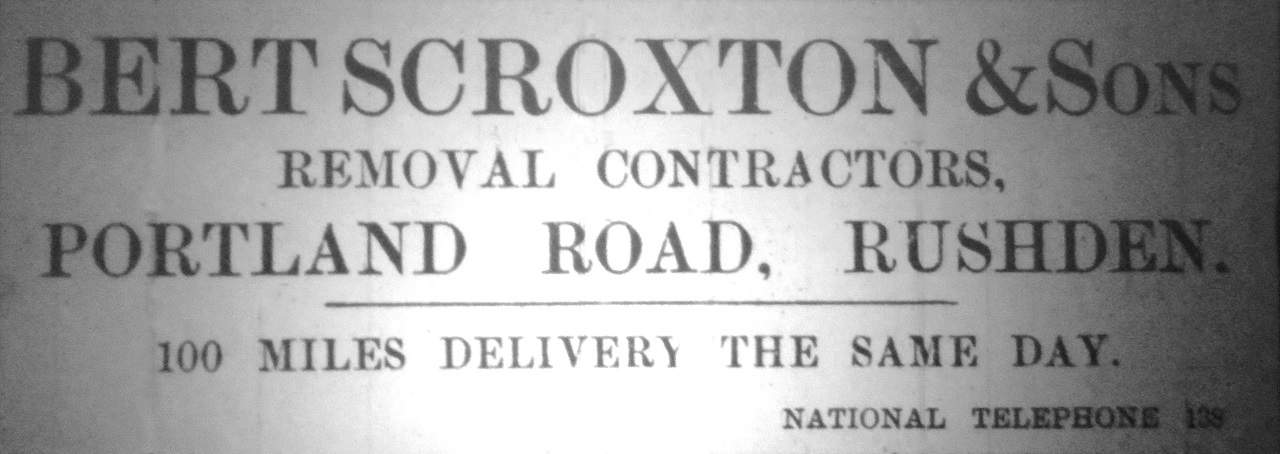
An advert from the Rushden Echo

A Scroxton invoice dated July 1916
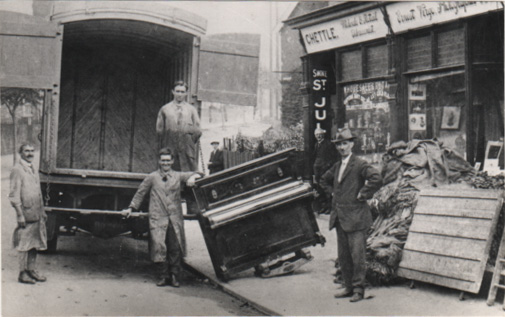
Scroxton men loading a piano in Higham Road
The Council’s programme of house building was going ahead and they received approval from the Ministry of Health to accept the tender of the Rushden Master Builders’ Association for the erection of the 24 houses mentioned at the cost of £19,245 9s. 3d., subject to such modifications as might be required by the Commissioner, but which would not prevent immediate commencement with the work. This now left the contracts allocated as follows:- Mr. W. Packwood, 16 houses in four blocks, £13,962; Mr. W. G. Wilmott, eight houses in four blocks, £6,730; Mr. R. Marriott, 18 houses in three blocks, £14,395.
With a view to comparing Rushden and Higham Ferrers new municipal houses with those at Northampton, a visit was paid to Weston Favell and Northampton by members of the Rushden and Higham Ferrers Water Board. The houses seemed to be better than the new houses in Rushden, but the rents were fixed at 18s a week whereas Rushden Council were trying to fix theirs at 8s a week.
A miner’s strike was threatened and the Rushden Echo reported that stocks of coal in Rushden were very low. There was very little coming into the town and that did not include a great deal of household coal. There were only nine trucks of coal on the lines at the Rushden M.R. station, and the contents were being rapidly distributed.
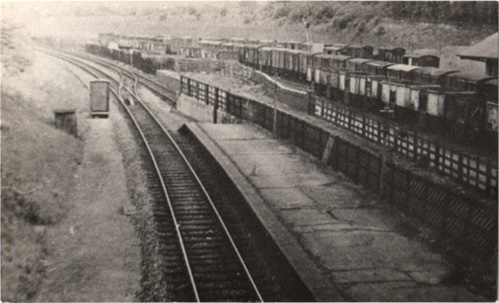
The goods sidings at Rushden Station
Also in September 1920 the Rushden Echo published more writings by Dr. Charles R. Fisher relating to Rushden Past and Present. In an article entitled ‘Places and things of antiquarian or of general interest’ Dr. Fisher talks about Spital Hill, later known as Rushden Hill and now called Higham Road. The hospital of St. James is thought to have stood at the top of this hill, or at least in that area. According to Dr. Fisher, in the 1850s this hill and the valley between it and the village was a very dark and lonely place. At the bottom of the hill, opposite to Hayway, there was a spinney and a stream ran across the road. Rumour had it that a ghost, named Bung Edi, lived under the bridge, and this was a real terror to any one who had to pass that way in the dark.

The bottom of Higham Road
Dr. Fisher also mentions Washbrook, and remembers the sheep being washed in the brook. The sheep were thrown into the water and the wool rubbed with a rubber, which was a piece of wood at the end of a long handle. The sheep would then scramble out ‘looking totally amazed at it all.’ He would watch this whilst playing truant from Mr. Knight’s school.
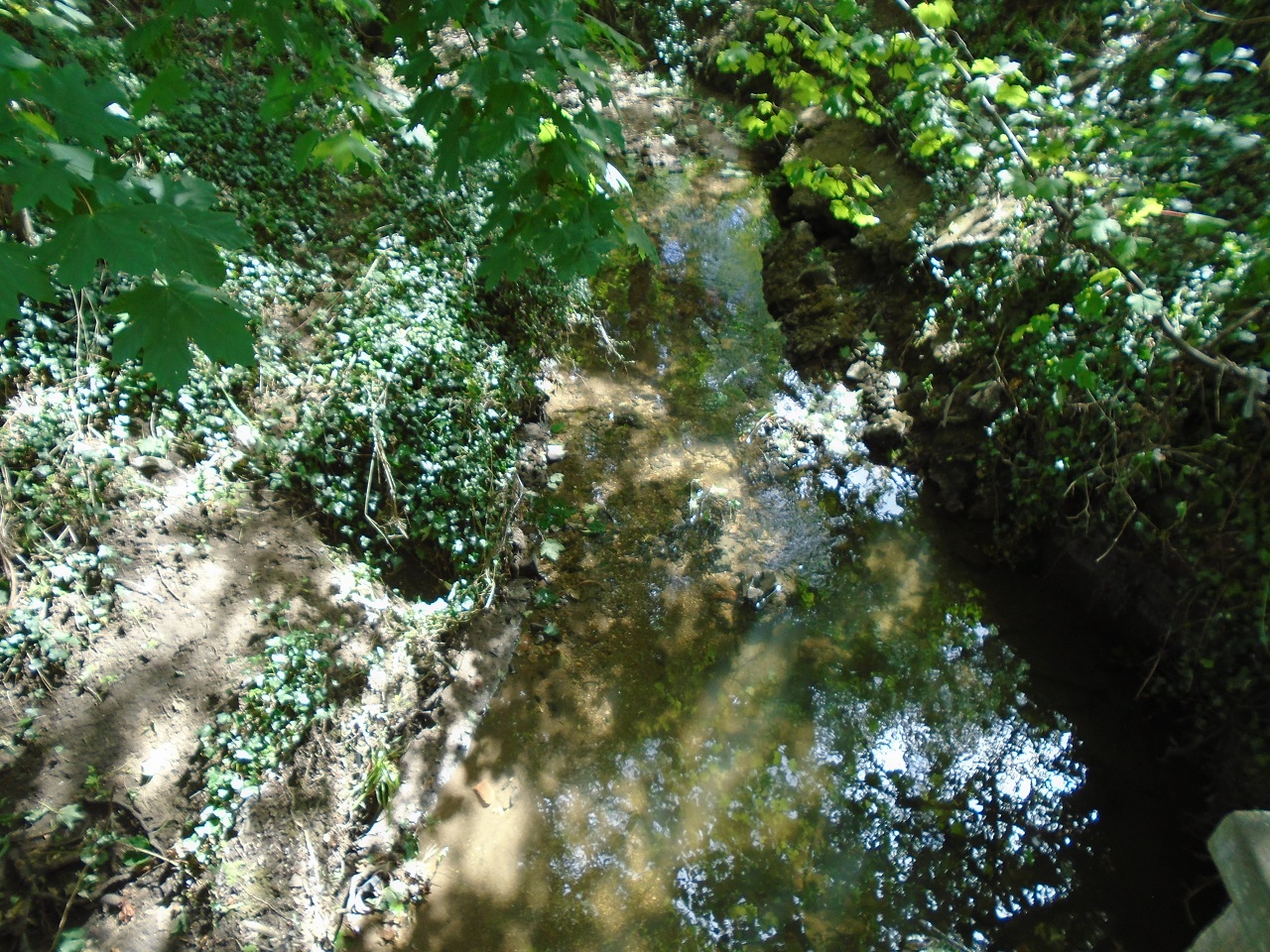
The brook running through what is now Spencer Park, not really suitable for washing sheep
Mr. Ebenezer Knight was a leading Baptist and secretary of the Sunday School. He started an independent school in a small building next to the church which had previously been the village poor house. It was very plain and uncomfortable. He had been a shoemaker by trade but had a reasonable education and the ability to teach. He received no wages except the fees of the scholars, but he was often engaged by the local farmers in the measuring of land or other things that required a knowledge of mathematics. He was noted for his sternness, but was also very fair, and the popular rhyme was:-
Mr. Knight he’s a very good man,
He tries to learn us all he can;
At reading, writing, arithmetic,
He never forgets to give us the stick.
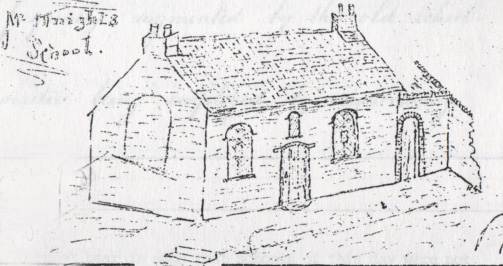
A sketch of Mr. Knight’s school
From the Rushden Echo on the 24 September 1920 – JUST ARRIVED. – Large consignment of Assorted Chocolates at the low price of 2s. per lb. Also due to arrive: Finest Crystallised sugar at 1s. per lb. Free of control. Sample on view at our High-street shop. Tailby and Putnam, Rushden and Irthlingborough.
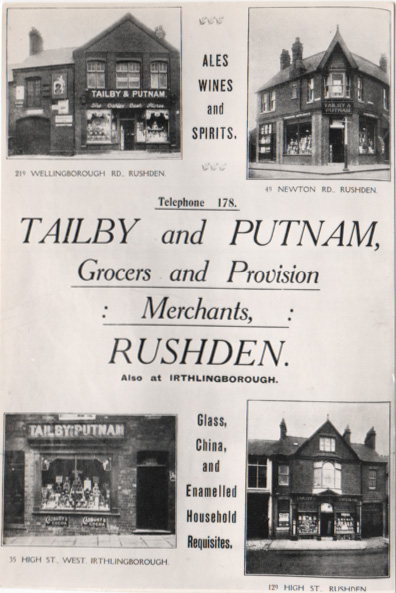

A stone jar with the name Tailby & Putnam

A collection of invoices from Tailby and Putnam sent to Mr. Joseph Knight, Irchester Road, Rushden.