

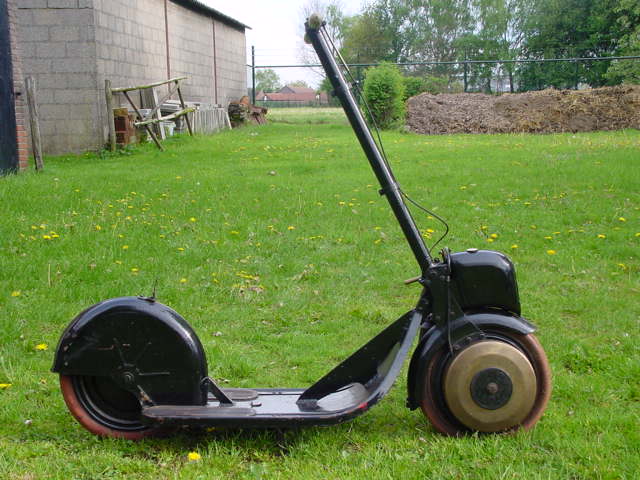
One hundred years ago this month a Rushden resident evidently treated himself for Christmas as he registered with the Northamptonshire County Council what was then a new-fangled Autoped motor scooter with the number BD3956 on Christmas Eve, 24 December 1919.
Autoped motor scooters were made in New York by the Autoped Co. of Long Island from 1915 to 1921 but the manufacture was taken over by Krupp in Germany from 1919 to 1922. You had to stand on the scooter to drive it and the handlebars folded down to make it easier to store or possibly to transport by train. It had a top speed of 20 mph.
The later Krupps model did have the addition of a seat making it more like the much later Vespa motor scooter of the late 1940’s.
The owner of the scooter was John Richard Heygate living at Union Bank Chambers. According to the 1901 census John was the son of Frank Heygate who was a bank cashier living at 17 Griffith St. with his family.
By 1911 the census of that year shows that Frank had been made manager of the bank and had moved to live in Union Bank House in the High Street with his family.

The Union Bank, Rushden

The same view in 2012, by that time the Nat West Bank

Nat West Bank 2019
John was called up for military service on 20 May 1918 as Private 58963 John Richard Heygate. Originally he was placed in the 7th Battalion, Duke of Wellington’s West Riding Regiment but was transferred to the 3rd Battalion, Northamptonshire Regiment and his occupation was shown as an apprentice engineer and student at Nottingham University. He was promoted to the acting, unpaid rank of Lance Corporal on 17 September 1918 while on the Isle of Sheppey. On 20 June 1918 he was admitted to the Military Hospital in Sheerness for 6 days with influenza. This was at the start of the deadly Spanish ‘flu outbreak which swept the world in 1918 and 1919 and it evidently affected John’s lungs. He was described by a medical officer as getting breathless after slight exertion and it was hurting him to breathe. The result was that he was medically discharged from the army on 29 March 1919 and given a 12 month pension as his condition was ruled to have been aggravated by his army service.
John was evidently something of a pioneer as he not only owned a very early form of motor transport but he is shown in the 1939 register as a Radio Dealer with his own business at 2 Grove Parade in the High Street at Slough in what were the early days of radio and TV.